
European Union AI Act Compliance Platform

integrity-sm

100s of hours

Saved on compliance

collaboration

54%

Less compliance costs

innovation

12 weeks

To get compliant

Turn AI Act readiness into a practical AI governance program

Manage EU AI Act readiness, AI risks, suppliers, data, controls, policies, evidence, human oversight and reporting in one connected platform.

The European Union Artificial Intelligence (AI) Act is changing how organisations build, buy, deploy and govern artificial intelligence.

It is not just another compliance framework. It is a risk-based regulatory model that asks organisations to understand where AI is being used, what risk it creates, who is accountable, what controls are in place and how human oversight, transparency, data governance, cyber security and evidence are managed over time.

For many UK and European organisations, the AI Act matters because AI is already moving faster than traditional compliance cycles. AI use cases can appear in days. Employees can adopt new tools without formal approval. Suppliers can embed AI into existing services. Customer, investor and procurement questions are becoming more specific.

AI governance touches risks, data, suppliers, policies, security, privacy, human oversight, documentation, training, evidence, accountability and ongoing monitoring. If those areas are managed across spreadsheets, inboxes, shared folders, supplier questionnaires and one-off policy documents, your AI governance position becomes difficult to explain and harder to defend.

de.iterate helps organisations manage EU AI Act readiness as part of one connected Data Governance program.

Instead of treating AI governance as a bolted-on module, de.iterate connects the doing parts: AI risks, controls, policies, evidence, suppliers, assets, data, assurance tasks and audit packs.

Compliance gives you a certificate. Risk management gives you confidence.

how-deiterate-simplifies-compliance-blog-newsletter

What is the EU AI Act?

The EU AI Act is the European Union’s legal framework for artificial intelligence. It was introduced to support trustworthy AI by setting rules for AI systems based on the level of risk they may create for people, safety, rights and society.

The AI Act asks organisations to know what AI they are using, understand the risks, apply the right controls and be able to show that AI is governed properly.

The AI Act takes a risk-based approach. The practical obligations depend on your role and your use case. An organisation may be a provider, deployer, importer, distributor, product manufacturer or other actor in the AI value chain.

For high-risk AI systems, the requirements can include areas such as risk management, data governance, technical documentation, record keeping, human oversight and more.

For organisations using AI, its governance needs to move from informal policy statements to a structured management system.
deiterate-platform

What is de.iterate?

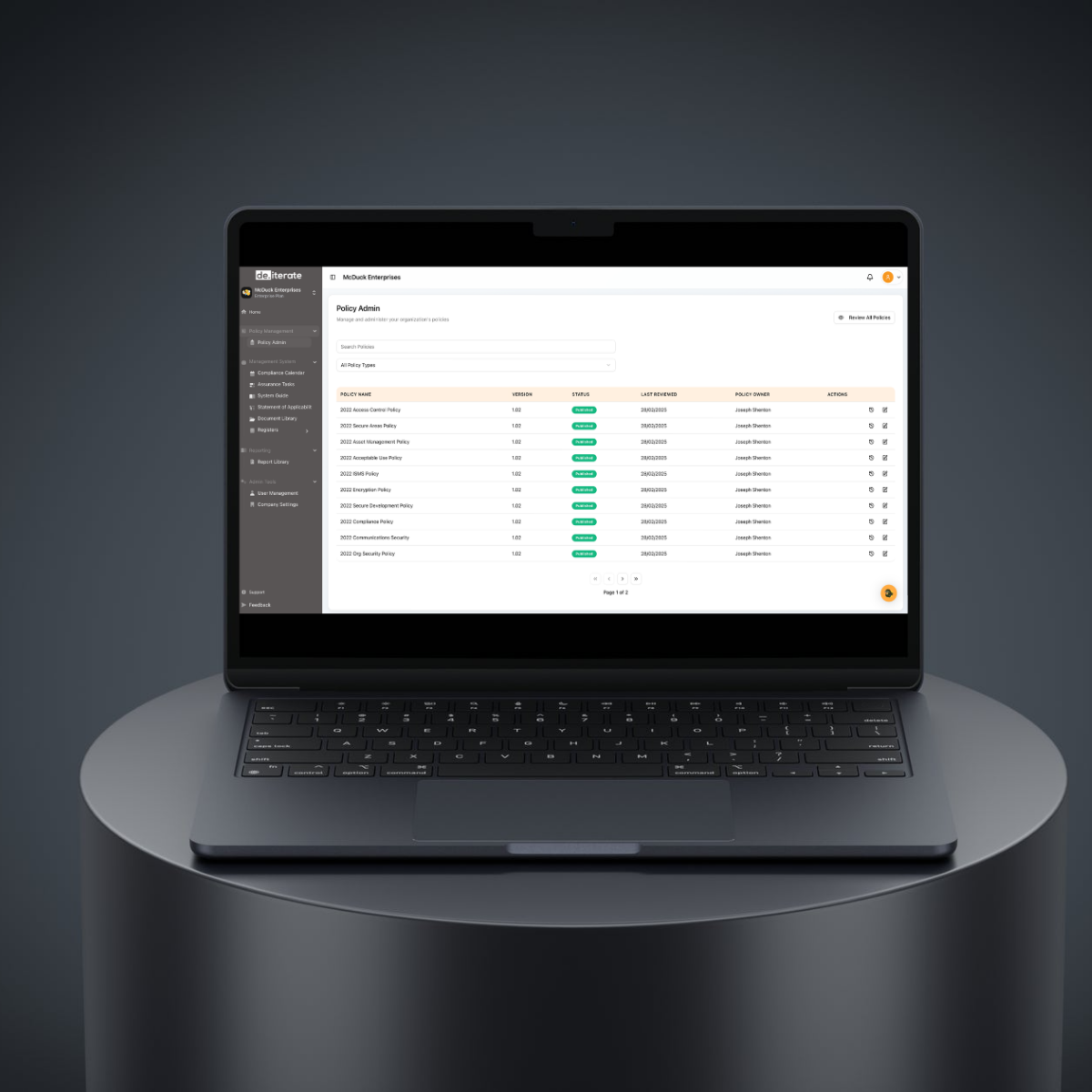
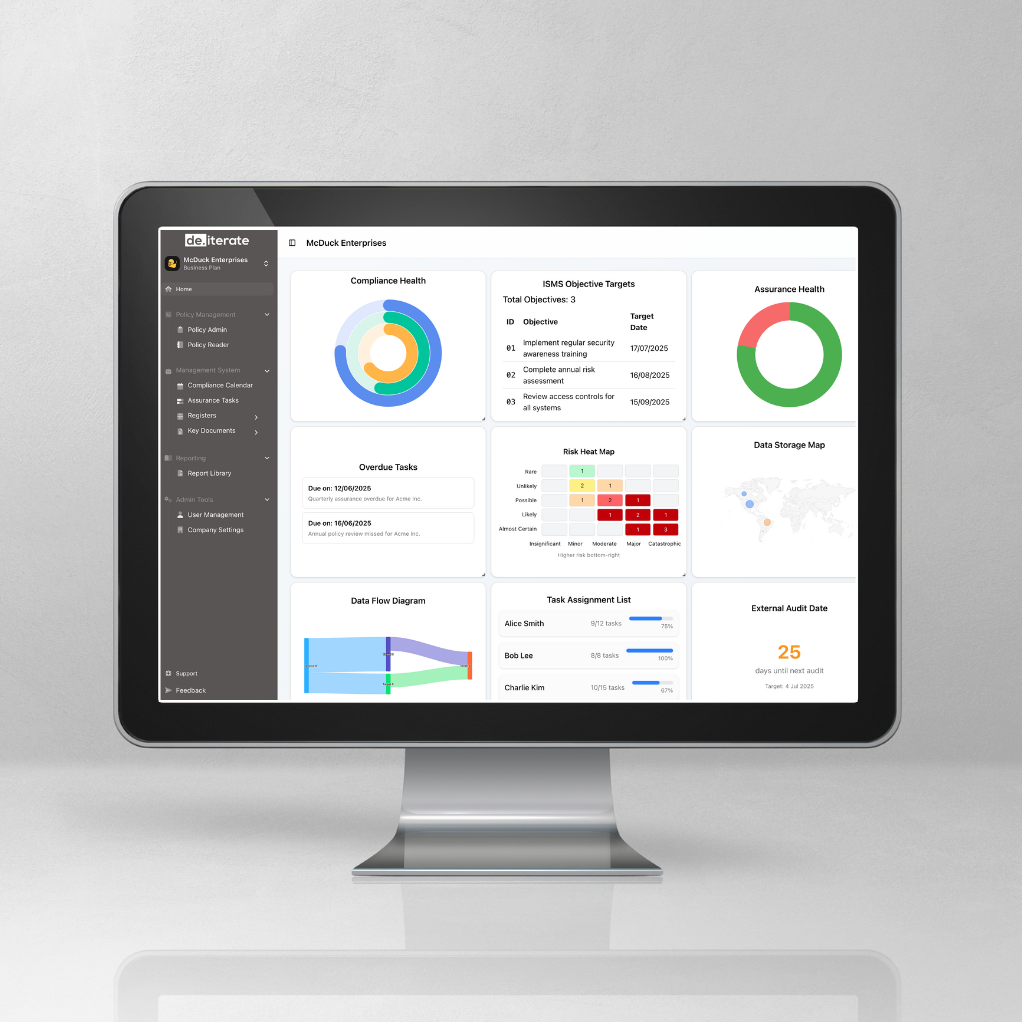
de.iterate helps organisations turn EU AI Act readiness into a living AI governance program.

Instead of managing AI governance through disconnected policies, spreadsheets, supplier notes and one-off risk reviews, de.iterate gives your team one platform to connect the moving parts.

Your AI use cases connect to your risks. Your risks connect to your controls. Your suppliers connect to your evidence. Your data connects to your policies. Your human oversight activities connect to your assurance tasks. Your leadership team can see what is current, overdue or at risk.

That is the difference between collecting compliance evidence and running a management system.

The EU AI Act is especially important for digital-first organisations that are building, deploying, buying or relying on AI across products, operations, customer service, recruitment, marketing, analytics, software development or decision support.

A lot of compliance tools help you gather evidence. de.iterate helps you build confidence that your AI risks are managed.

Benefits of EU AI Act readiness with de.iterate

A lot of compliance tools help you collect evidence. de.iterate helps you build assurance.

European Union Artificial Intelligence Act readiness is not just about proving that a policy exists. It is about building the operating rhythm behind AI governance: clear ownership, active risk management, supplier oversight, data governance, human oversight, policy management, evidence capture, review cycles and management reporting.

de.iterate helps organisations move from reactive AI compliance activity to a more defensible AI governance program.
integrity-sm

Understand where AI is being used

You cannot govern AI if you do not know where it is being used.

de.iterate helps you build a clearer view of your AI landscape by connecting AI use cases to assets, suppliers, data types, risks, policies, controls and evidence. Your team can see what is known, what is approved, what needs review and where unmanaged AI risk may be emerging.

collaboration

Classify and prioritise AI risk

The AI Act is built around risk. Organisations need a practical way to understand which AI systems matter most, which obligations may apply and which risks need treatment.

de.iterate helps turn AI risk classification into action by linking AI use cases to your existing risk register, data register, supplier register, policies, controls, assurance tasks and evidence.

innovation

Be ready for audits and reviews

Cyber risk does not wait for audit season. Assets, users, suppliers, vulnerabilities, AI use and customer expectations all change. de.iterate helps you maintain assurance through recurring tasks, review cycles, evidence capture, ownership tracking and reporting, so your team can show progress and control between formal review points.

multiple-frameworks

Reduce duplication across frameworks

Most organisations preparing for EU AI Act readiness are not starting from a blank page. They may already be working with ISO 27001, DORA, Cyber Essentials, or SOC 2. The problem is that each framework often creates another register, another evidence request and another reporting process.

de.iterate reduces that duplication by connecting your controls, risks, policies, assets, suppliers and evidence across frameworks through one management system.

harold-quackmore

Manage AI governance

AI governance is practical, but it still needs ownership. Someone needs to know which AI systems are in scope. Someone needs to approve use cases. Someone needs to assess suppliers. 

de.iterate helps bring that work together in one platform, so AI risk is not hidden inside technical teams, product teams, procurement processes or informal staff behaviour.

migrate-faster

Migrate quickly & easily

If you already manage NIS2, ISO 27001 or broader compliance in spreadsheets, folders or another tool, moving to de.iterate does not mean starting again. de.iterate’s Management System Migration Tool helps bring across existing policies, registers and supporting documentation from legacy systems, so you can preserve the work you have already done and move into a more structured operating model.

Everything you need to run and prove EU AI Act readiness

Governance and policy management

Create, manage and review the policies and procedures that support EU AI Act readiness, including AI acceptable use, AI system approval, AI risk assessment, human oversight, transparency, supplier governance, data governance, incident handling, security, privacy and staff training.

Keep documents current, assigned and connected to the controls, risks and AI use cases they support.


Assurance and evidence

Operationalise EU AI Act readiness through assurance tasks, checklists, evidence collection and review cycles. Store contextual evidence against the relevant AI use case, risk, control, supplier, policy, data type or oversight activity, rather than leaving it scattered across screenshots, folders, inboxes or project tools.

This gives your team a clearer evidence trail and reduces the scramble when customers, auditors, partners, regulators or stakeholders ask for proof.

Risk and other registers

EU AI Act readiness depends on knowing what AI is being used, what data it touches, who owns it, which suppliers are involved and how risks are controlled.

Use de.iterate to connect your AI use case register, risk register, asset register, supplier register, data register, incident register and control environment, so your AI governance program reflects how the business operates. This helps your team manage scope, ownership, treatment plans, suppliers and more.

policy-calendar

Automation where it helps. Context where it matters.

The EU AI Act is not a checkbox exercise.

A platform can help organise evidence, map controls, track actions, highlight gaps and reduce repetitive administration. But it cannot replace business judgement.

It cannot decide whether an AI use case is acceptable. It cannot decide whether human oversight is meaningful. It cannot decide whether a supplier risk should be accepted. It cannot decide whether data use is appropriate. It cannot make management accountable.

That judgement still needs people who understand the business, the risks, the systems, the suppliers, the data and the customers.

That is where de.iterate is different. We do not compete on evidence collection. We compete on confidence.

de.iterate helps surface risk wherever it sits in your business and supports the governance work that follows. AI and automation can sharpen the judgement, but humans remain accountable.

That is how EU AI Act readiness becomes more than a compliance project. It becomes part of a living risk management program.


Frequently Asked Questions

Got questions? Luckily, we've got answers!

After all, we're here to help you get your ducks in a row.

What is the EU AI Act?

The EU AI Act is the European Union’s legal framework for artificial intelligence.

It sets rules for AI systems based on risk, with stronger obligations for systems that may affect safety, rights, access to services, employment, education, law enforcement, migration, critical infrastructure or other sensitive areas.

Who does the EU AI Act apply to?

The EU AI Act can apply to different actors in the AI value chain, including providers, deployers, importers, distributors and product manufacturers.

It can also affect organisations outside the EU where AI systems are placed on the EU market, used in the EU, or where the output of an AI system is used in the EU.

Your obligations depend on your role, the AI system, the use case, the risk category and the relevant timing.

What does the EU AI Act cover?

The EU AI Act covers AI systems using a risk-based model.

It includes rules for prohibited AI practices, high-risk AI systems, transparency obligations, general-purpose AI models and minimal-risk AI systems.

In practical terms, organisations may need to understand AI use cases, classify risk, manage data governance, maintain documentation, provide transparency, ensure human oversight, manage suppliers, monitor performance, handle incidents and maintain evidence.

What is a high-risk AI system?

A high-risk AI system is an AI system that may create significant risks to health, safety or fundamental rights.

Examples can include AI used in employment, education, critical infrastructure, essential services, law enforcement, migration, border control, justice or certain regulated products.

High-risk AI systems are subject to stricter obligations, including risk management, data governance, technical documentation, logging, human oversight, transparency, accuracy, robustness and cyber security.

What are prohibited AI practices?

Prohibited AI practices are uses of AI considered to create unacceptable risk.

These include certain forms of harmful manipulation, exploitation of vulnerabilities, social scoring, certain biometric uses and other practices that threaten safety, rights or democratic values.

Organisations should understand whether any AI systems or supplier tools they use could create prohibited or unacceptable risk.

What is the difference between the EU AI Act and ISO 42001?

The EU AI Act is a legal framework for AI regulation in the European Union.

ISO 42001 is an international management system standard for artificial intelligence.

They are different, but they work well together.

The AI Act sets legal obligations based on risk, role and use case. ISO 42001 provides a structured management system approach for governing AI across policies, roles, risks, objectives, controls, performance evaluation and continual improvement.

de.iterate helps organisations manage both through one connected platform, so AI risks, controls, policies, suppliers, data and evidence do not need to be rebuilt for each framework.

What is the difference between the EU AI Act and GDPR?

The EU AI Act focuses on artificial intelligence systems and their risks.

GDPR focuses on personal data protection.

They often overlap because AI systems frequently use, generate or affect personal data. An AI system may need both AI governance and privacy governance, especially where personal information is used for profiling, automated decision support, customer service, employment decisions, marketing, analytics or model training.

de.iterate helps organisations connect AI governance with privacy governance through one Data Governance program.

Can de.iterate make us EU AI Act compliant?

No platform can automatically make an organisation compliant with the EU AI Act.

AI Act readiness depends on your AI systems, your role, your use cases, your data, your suppliers, your risk classification, your controls, your documentation, your oversight and your legal obligations.

de.iterate helps you manage the work behind EU AI Act readiness: AI use case registers, risk assessment, control ownership, policy management, supplier oversight, data governance, evidence, assurance tasks, registers and reporting.

Is AI governance just a legal or compliance responsibility?

No. AI governance touches legal, compliance, technology, product, security, privacy, risk, procurement, HR, marketing, operations and leadership.

Legal teams may interpret obligations. Compliance teams may coordinate the program. Technology and product teams may own systems. Procurement may manage suppliers. Security and privacy teams may control risk. Leadership remains accountable for decisions.

How does the EU AI Act affect suppliers?

The AI Act places obligations on different actors across the AI value chain.

For many organisations, AI risk enters through suppliers: AI-enabled software, SaaS platforms, model providers, analytics tools, HR tools, marketing platforms, customer service systems, productivity tools and outsourced service providers.

de.iterate helps connect suppliers to AI use cases, risks, data, controls, contracts, policies, evidence and assurance tasks, so AI supplier risk is easier to manage and easier to explain.

Simple monthly pricing, based on the frameworks you need

de.iterate's monthly pricing is structured around the compliance frameworks you choose to access, giving you the flexibility to build a program that fits your organisation’s needs. Every plan includes access to the de.iterate platform and its feature set, from automated and expert-led onboarding, through to migration support, assurance workflows, live registers, compliance reporting and the core documentation needed to run and maintain your management system with confidence.
AUD
GBP
Starter (per month)

$179£100

  • Cyber Essentials

  • Essential Eight

  • SMB 1001

  • Privacy Acts

  • DISP

Business (per month)

$2,100£1,250

  • ISO 27001

  • ISO 27701

  • ISO 42001

  • ISO 9001

  • ISO 45001

  • ISO 14001

  • SOC 2

  • NIST CSF 2.0

  • NIST 800-53

  • NIST 800-171

  • NIST 800-172

  • GDPR

  • Essential Eight

  • SMB 1001

  • Privacy Acts

  • DISP

  • DORA

  • NIS2

  • European Union's AI Act

  • CIS v8

  • TISAX

  • Cyber Essentials

Enterprise (per month)

$3,500£2,000

  • ISO 27001

  • ISO 27701

  • ISO 42001

  • ISO 9001

  • ISO 45001

  • ISO 14001

  • SOC 2

  • NIST CSF 2.0

  • NIST 800-53

  • NIST 800-171

  • NIST 800-172

  • GDPR

  • Essential Eight

  • SMB 1001

  • Privacy Acts

  • DISP

  • ISM

  • SOCI

  • Right Fit for Risk (RFFR)

  • DORA

  • NIS2

  • European Union's AI Act

  • CIS v8

  • TISAX

  • Cyber Essentials

Ready for simple, stress-free compliance? Want help from real GRC experts?