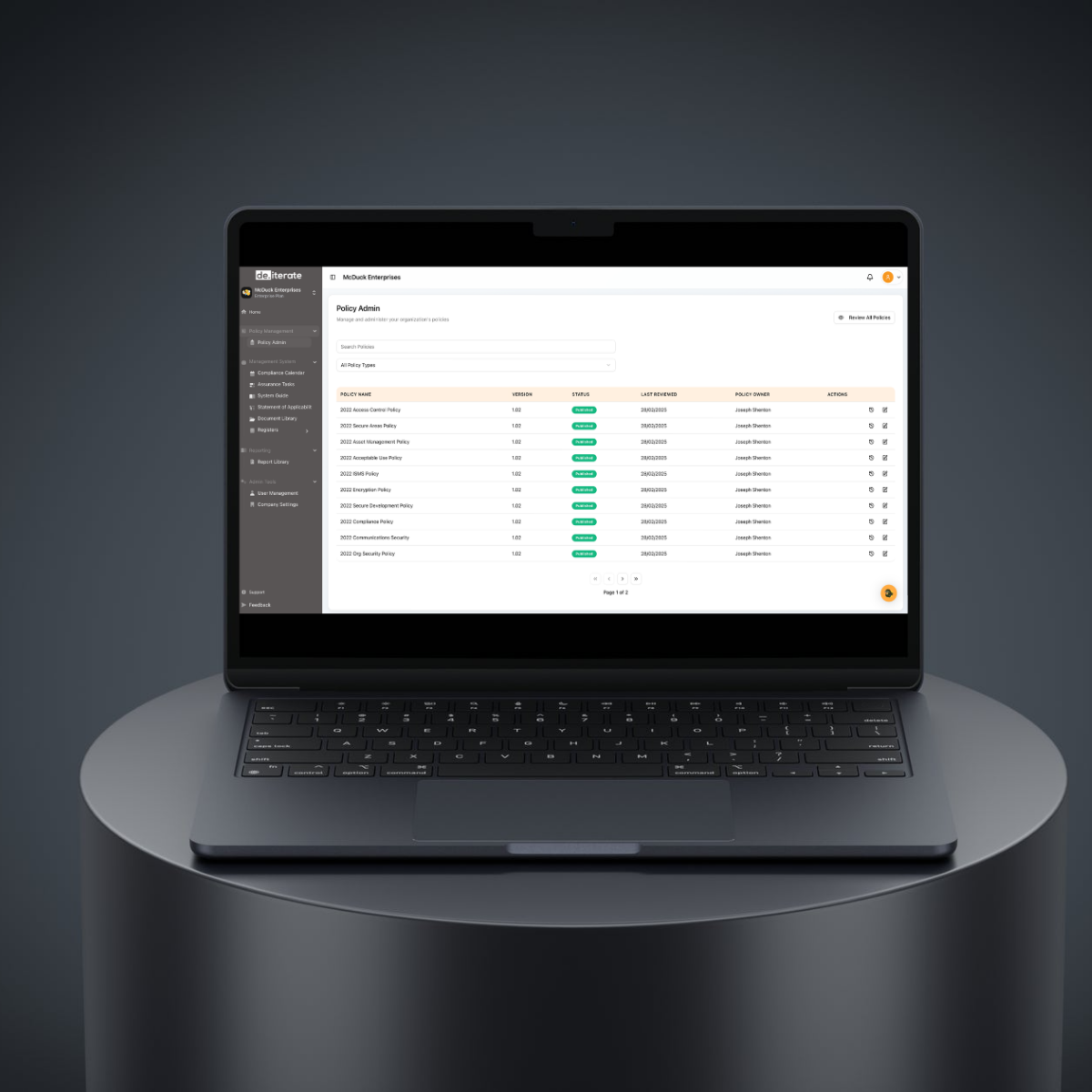
de.iterate is an Australian GRC platform with controls management and controls testing built in. Writing a control down takes five minutes. Showing it has operated every month for three years takes a system. de.iterate links each control to what it protects, schedules the testing and keeps the evidence together.
Instead of managing policies in one place, risks in another, evidence in folders, and audits through a last-minute scramble, de.iterate connects the whole system. That means better visibility, clearer ownership, stronger assurance and less time lost to manual admin. The current platform spans policies, assurance tasks, registers, evidence, reporting, Trust Centre capabilities, auditor access and support for multiple frameworks.
We help you get your ducks in a row.
A control owner finds out they own a control when the auditor asks for evidence. Testing happens in one frantic burst. The screenshot that proves it all is in someone’s inbox, and that someone left in March.
Larger organisations have a controls library, and the problem has scaled with it. Four hundred controls sit in the GRC platform, each with an owner assigned during implementation, and a third of those owners have since moved roles. Testing runs to a calendar, so the same control is tested in March for ISO, in June for SOC 2 and in September by internal audit, with three sets of evidence filed in three places by three teams who don’t compare notes. The control owner answers all three requests with the same screenshot and starts to wonder why anyone needs it.
Either way, the evidence exists and nobody can find it when it counts.
A control is only worth having if someone owns it, it gets tested often enough to be trusted, and the evidence lives somewhere other than an inbox. de.iterate builds controls that way. Each control is mapped once across every framework it satisfies, testing is broken into scheduled tasks with named owners, evidence stays attached to the control it proves, and integrations with your security tooling check that what the control says matches what the systems show.
Link any control to multiple risks, obligations, assets and policies. Start from a control library that's already mapped across frameworks, so one control can count towards ISO 27001, SOC 2 and Essential Eight together.
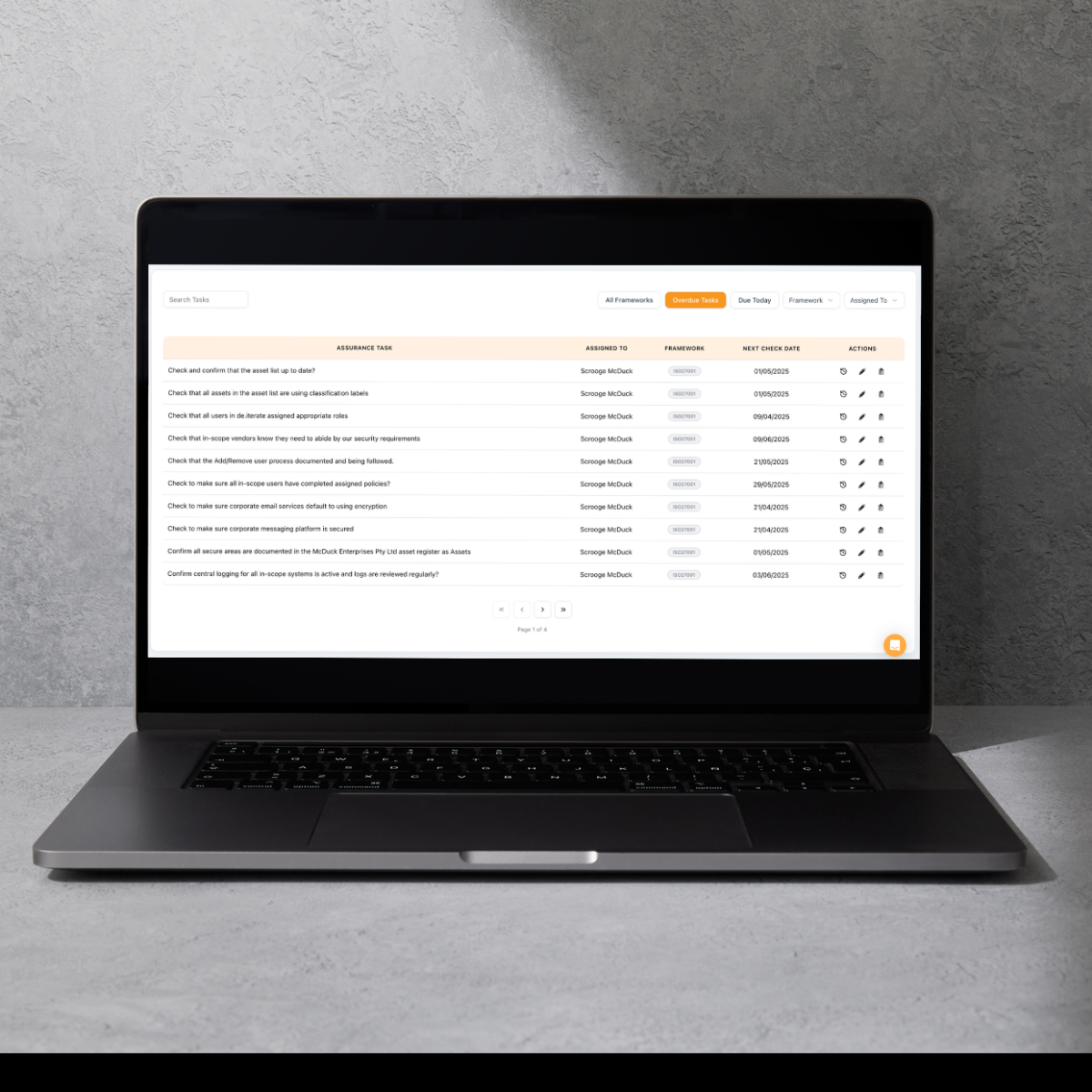
Assurance Tasks break testing into scheduled activities, each with an owner and a due date. Scheduling rules set how often each task falls due, and de.iterate sends the reminders.
Document each control's design, then assess its design and operating effectiveness with evidence attached. Assurance Checklists turn repeatable reviews into checklists you can send to colleagues or third parties.
de.iterate enriches your asset register with integration data from your technology vendors like Microsoft Intune, Jamf, CrowdStrike, Microsoft Defender and SentinelOne, and can alert when providers views drift.
Attach evidence to the control it proves, with the date and the person who collected it. Every framework that relies on that control draws on the same evidence, so one screenshot answers the ISO auditor, the SOC 2 assessor and internal audit without three separate requests.
When a test shows a control isn’t working, de.iterate raises a finding, assigns a corrective action and tracks it to closure. Because control effectiveness feeds residual risk, the risks that depend on that control update at the same time, so the register reflects the gap until it’s fixed.
Most questions about controls come down to the work involved: how much of it there is, who does it, and whether the auditor can see the result without a week of preparation. The answers below cover the detail, from the control library you start with to where the evidence ends up.
In de.iterate, an Assurance Task is a scheduled activity with an owner, a due date and evidence attached, such as a quarterly user access review. An Assurance Checklist is a repeatable set of steps or questions, such as a new starter checklist or a supplier questionnaire, that you can send to others to complete.
Yes. Your auditor can log in to the de.iterate Auditor Portal to review controls and evidence, or you can export your artifacts for them to review offline.
Design effectiveness asks whether a control would manage the risk if it ran as intended. Operating effectiveness asks whether it actually ran that way over a period of time. Auditors look for evidence of both.
No. de.iterate includes a ready-to-use control library that's already mapped across frameworks. Tailor it to your organisation and add your own controls where you need to.
In de.iterate, each Assurance Task has an owner and a due date. Scheduling rules set how often it recurs, and de.iterate sends reminders so nothing is left to the fortnight before the audit.
Yes. de.iterate's AI-powered assurance analyses the documents you upload, identifies gaps and suggests tasks and control mappings. Every suggestion arrives as a draft for a person to approve.
In de.iterate's Evidence Store, linked to the task, control or requirement it supports, so you and your auditor can find it straight away.
From setup to scale, every feature is designed to help your team save time, stay focused, and drive meaningful results.
de.iterate combines technology with hands-on support from experienced GRC professionals based in Australia. From onboarding through to certification, our team works with you to build momentum quickly, helping many organisations get audit-ready in less than 12 weeks and providing practical support through external audits and ongoing compliance activities.
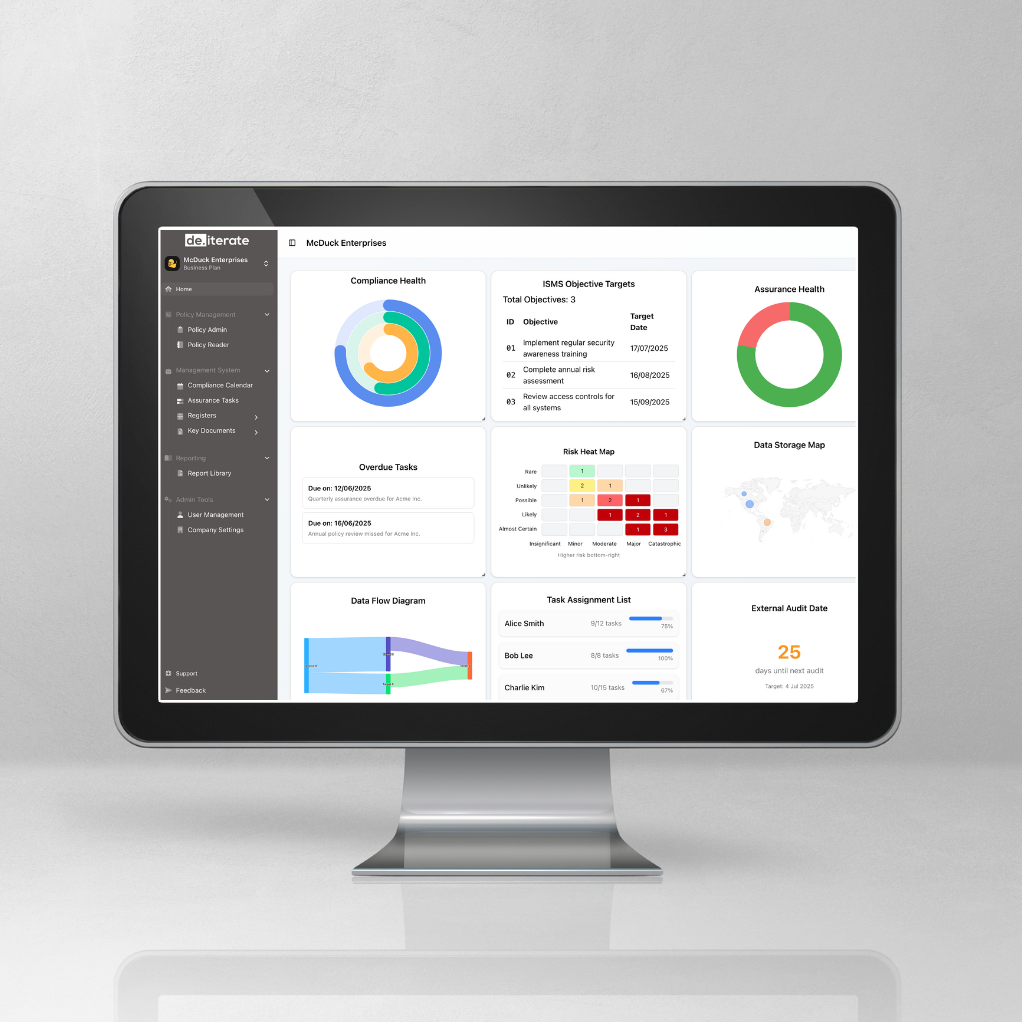
Great compliance is not built in the two weeks before an audit. de.iterate helps you stay ready year-round with assurance tasks, checklists, live registers, reporting and a compliance calendar that keeps momentum going.
From start-ups to enterprise, de.iterate supports multiple frameworks in one system, including ISO 27001, ISO 27701, ISO 9001, ISO 14001, ISO 45001, Privacy Acts, SOC 2, DIP, Essential Eight and more. You can grow your compliance maturity without rebuilding everything from scratch.
Many tools stop at storage. de.iterate goes further by connecting your policies, controls, evidence, registers and assurance activity in context. That means your documentation is not just centralised, it is structured, linked and easier to defend.
We believe compliance should be simpler, clearer and more achievable. That is why de.iterate combines structured workflows, smart documentation, migration support and guided onboarding with a platform that is intuitive enough for teams to use every day.
de.iterate is designed for the way organisations actually work. Policies, risks, assets, incidents, suppliers, evidence, audits and reporting all sit in one integrated platform, so compliance becomes part of business as usual.
A risk register with a pulse, with inherent and residual scoring, heatmaps and risk appetite.
Every obligation traced to the evidence that meets it, across 25+ frameworks.
Plain-English policies, clear approvals and proof your staff have read them.
ISO 42001, AI impact assessments and an inventory of the AI in your business.
Find your personal information, see where it goes and keep your privacy policy current.
ISO 9001, ISO 14001 and ISO 45001, running alongside everything else you manage.

With de.iterate, the complexity of managing multiple frameworks doesn’t translate into increased workload. Our unified platform serves as a central hub for overseeing all your compliance activities, whether you’re working with bespoke frameworks or seeking to meet the criteria of the most sought-after security and privacy standards and certifications.
The global standard for building EMS. It gives you a structure to identify environmental impacts, manage obligations, strengthen governance.
This standard specifies the requirements for managing AI systems responsibly and ethically. It helps ensure trustworthy development and use of AI.
This specifies how organisations should manage their customer’s data. It is one of the most sought-after security framework for SaaS companies.
Country-specific legislative frameworks established to protect individuals’ personal information from misuse, interference, unauthorised access, modification, and disclosure.
The Australian Government’s Department of Employment and Workplace Relations uses the External Systems Accreditation Framework and the RFFR approach to assess and accredit third party service providers and systems.
DISP is a critical initiative that ensures businesses in the defence supply chain meet stringent security requirements. DISP compliance is essential for companies that engage in Defence tenders, contracts and projects.
de.iterate pricing is structured around the compliance frameworks you choose to access, giving you the flexibility to build a program that fits your organisation’s needs. Every plan includes access to the de.iterate platform and its feature set, from automated and expert-led onboarding, through to migration support, assurance workflows, live registers, compliance reporting and the core documentation needed to run and maintain your management system with confidence.
Essential Eight
SMB 1001
Privacy Acts
DISP
Cyber Essentials
ISO 27001
ISO 27701
ISO 42001
ISO 9001
ISO 45001
ISO 14001
SOC 2
NIST CSF 2.0
NIST 800-53
NIST 800-172
NIST 800-172
GDPR
Essential Eight
SMB 1001
Privacy Acts
DISP
Cyber Essentials
DORA
NIS2
CIS v8
EU AI Act
TISAX
ISO 27001
ISO 27701
ISO 42001
ISO 9001
ISO 45001
ISO 14001
SOC 2
NIST CSF 2.0
NIST 800-53
NIST 800-171
NIST 800-172
GDPR
Essential Eight
SMB 1001
Privacy Acts
DISP
ISM
SOCI
Right Fit for Risk (RFFR)
Cyber Essentials
DORA
NIS2
CIS c8
EU AI Act
TISAX
See how scheduled controls testing works in a live demo.