
Saved on compliance

Less compliance costs

To get certified

Build, manage and prove a cyber security program that works in practice, not just on paper. de.iterate helps organisations implement and maintain NIST CSF 2.0, NIST SP 800-53, NIST SP 800-171 and NIST SP 800-172 through one integrated platform for policies, risks, controls, evidence, audits and continuous assurance.
NIST frameworks are some of the most widely recognised cyber security frameworks in the world. They help organisations strengthen governance, manage cyber risk, implement defensible controls and demonstrate trust to customers, partners, regulators and government stakeholders. NIST CSF 2.0 provides high-level cyber security outcomes and profiles for managing risk, while the 800-series publications provide more detailed control and security requirement guidance.
The problem is not the frameworks themselves. The problem is how most organisations try to implement them.
Policies get copied from templates. Controls are tracked in spreadsheets. Requirements are interpreted inconsistently across teams. Evidence ends up scattered across folders and inboxes. Audit preparation becomes a scramble. What should be a living management system turns into a stressful, once-a-year project. de.iterate changes that by turning NIST-aligned compliance into a practical, ongoing way of working.
The NIST family gives organisations different ways to structure and strengthen cyber security, depending on their requirements, industry and maturity.
In plain English: NIST gives you a structured way to govern cyber risk, implement controls and prove that security is being managed seriously.
Done properly, these frameworks help organisations move beyond reactive security and build programs that are clearer, more defensible and more scalable. They are not about creating more paperwork. They are about putting the right controls, responsibilities and evidence in place for your organisation.
NIST CSF 2.0 provides guidance to manage cyber security risk through a taxonomy of high-level outcomes that organisations can use regardless of size, sector or maturity. It helps organisations understand, prioritise and communicate cyber security efforts more clearly.
NIST SP 800-53 provides a comprehensive catalogue of security and privacy controls for information systems and organisations. It is often used where organisations need a deeper, control-based model for building and assessing security and privacy programs.
NIST SP 800-171 sets out security requirements for protecting Controlled Unclassified Information (CUI) in nonfederal systems and organisations. It's important for organisations working in US government supply chains or handling controlled government information.
NIST SP 800-172 supplements 800-171 with enhanced security requirements designed to provide additional protection for CUI associated with critical programs or high-value assets, including protection against advanced persistent threats.
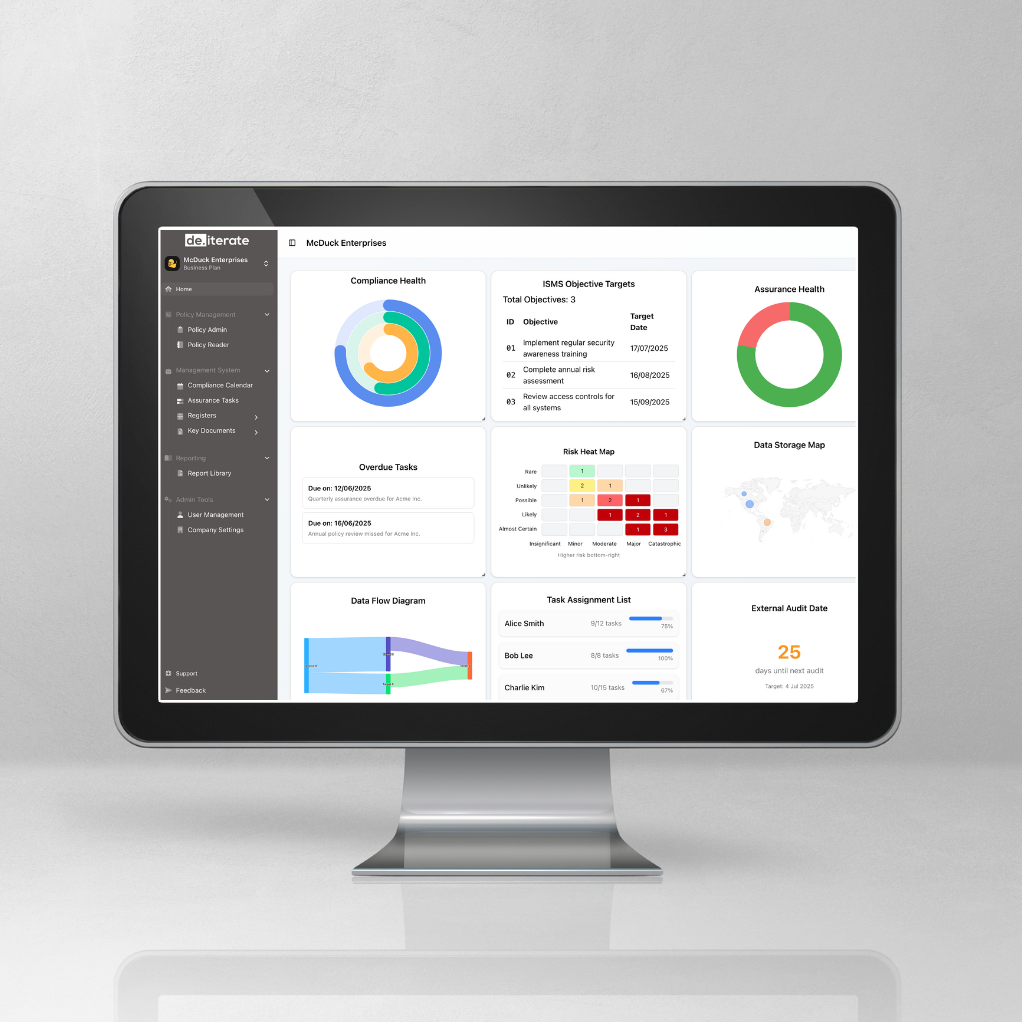
de.iterate makes NIST implementation simpler, clearer and more sustainable.
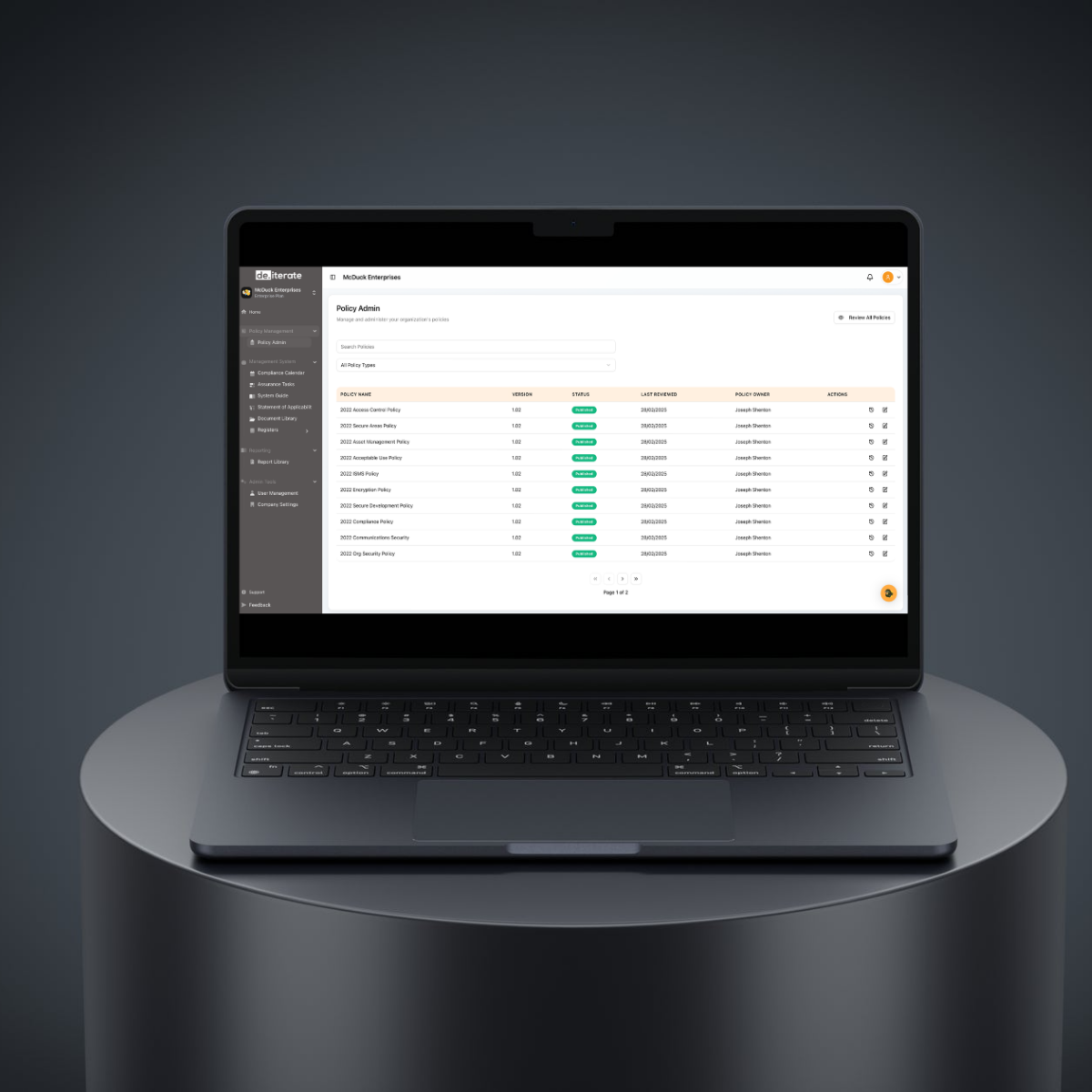
Instead of stitching together Word documents, spreadsheets, shared folders and manual reminders, you get one integrated platform that helps you manage the full lifecycle of your ISMS. Policies, training, risk registers, asset registers, evidence, assurance tasks, audits and reporting all sit in one place — connected, current and easier to maintain.
A lot of compliance tools help you collect activity. de.iterate helps you build assurance. This means your policies align to the way your business actually works. Your evidence connects to the right risks, assets and controls. Your audit trail makes sense. And your management system becomes something the business can maintain — not something it has to reinvent every year.
This is the difference between a platform that helps you prepare for an annual audit and one that helps you run a genuinely effective ISMS.
de.iterate delivers modern, scalable governance in a simple, plain-language platform that fits your business — not the other way around.
More than a checklist. More than automation. de.iterate delivers real governance programs that connect risk, compliance, privacy, safety, quality, and environmental management, all in one place. We make governance and compliance easy in a plain-language, scalable platform that keeps your business in control, audit-ready, and confident every day.

de.iterate helps you see where your compliance program is strong, and where it needs work. By giving you a clearer view of your documentation, controls, evidence and assurance activity, the platform makes it easier to run a practical gap assessment, prioritise actions and close issues before they become audit problems.
Create, manage and distribute policy content through Policy Management, Policy Reader, Dynamic Privacy Policy, the Control Library, the Integrated Management System Guide and the Compliance Documentation Repository. Keep critical documents current, readable and connected to the frameworks and controls they support.
Operationalise your compliance program through automated Assurance Tasks, Checklists, and our Compliance Calendar. Store contextual evidence that maps directly to specific controls. Turn your organisation's compliance program into a repeatable workflow with clear ownership, less chasing and stronger audit trails.
Manage what matters most to your organisation through our embedded risk management approach, with a Risk Register, Asset Register, Supplier Register, Incident Register and Privacy Register. Bring all your scope, ownership, treatment plans, classifications and review cycles together in one easy-to-use platform.
Plenty of platforms promise automation. de.iterate goes further by making that automation useful.
We don't just help you collect evidence. We help you understand whether the evidence is connected to the right risk, the right asset, the right control and the right process. We don't just store policies. We help you keep them aligned to the way your business actually operates. We don't just prepare you for an audit. We help you build a management system that stays healthy long after the audit is over.
That is the difference between a tool that creates activity and a platform that creates assurance.

Got questions? Luckily, we've got answers!
After all, we're here to help you get your ducks in a row.
The NIST compliance process can take anywhere from a few hours to 3 months, depending on your pace. Once you’re onboard in de.iterate, you’ll have all the tools and information you need to get certified in the fastest, easily way possible.
While NIST compliance doesn’t follow a strict audit cycle like ISO 27001, regular internal reviews and assessments are recommended to ensure ongoing compliance. With de.iterate, continuous monitoring and improvement are built into your process, keeping you aligned with NIST standards year-round.
Direct assessments by de.iterate aren’t possible due to the nature of NIST’s framework, which emphasises self-assessment and continuous improvement. However, we provide comprehensive tools and guidance to ensure you’re fully prepared for any external reviews or self-assessments.
Yes, we can organise to attend your next NIST compliance assessment either virtually or in-person. Talk to one of the team today about your options at hello@deiterate.com.
If your business handles customer data, especially in a cloud environment, NIST compliance is strongly recommended. It’s particularly crucial if you’re a SaaS provider, cloud computing service, or any business that stores, processes, or transmits customer data. Compliance not only enhances security but also builds customer trust and opens up new business opportunities.
NIST CSF 2.0 is a high-level cybersecurity risk management framework that helps organisations understand, prioritise and communicate cybersecurity outcomes. The 800-series publications go deeper: SP 800-53 provides a broad catalogue of security and privacy controls, SP 800-171 sets requirements for protecting Controlled Unclassified Information (CUI) in nonfederal systems, and SP 800-172 adds enhanced requirements for more advanced threat scenarios.
That depends on why you need NIST. If you want a flexible, broadly applicable way to structure cyber risk management, NIST CSF 2.0 is often the best place to start. If you need a detailed controls framework, SP 800-53 may be more appropriate. If you handle CUI as part of a U.S. government or defence-related supply chain, SP 800-171 is usually the key reference point, with SP 800-172 relevant where enhanced protections are expected.
NIST SP 800-53 provides a comprehensive catalogue of security and privacy controls for information systems and organisations. It is often used where organisations need a detailed, control-based structure for building, assessing or strengthening their cybersecurity and privacy programs.
ISO 27001
ISO 27701
ISO 42001
ISO 9001
ISO 45001
ISO 14001
SOC 2
NIST CSF 2.0
NIST 800-53
NIST 800-171
NIST 800-172
GDPR
Essential Eight
SMB 1001
Privacy Acts
DISP
ISO 27001
ISO 27701
ISO 42001
ISO 9001
ISO 45001
ISO 14001
SOC 2
NIST CSF 2.0
NIST 800-53
NIST 800-171
NIST 800-172
GDPR
Essential Eight
SMB 1001
Privacy Acts
DISP
ISM
SOCI
Right Fit for Risk (RFFR)