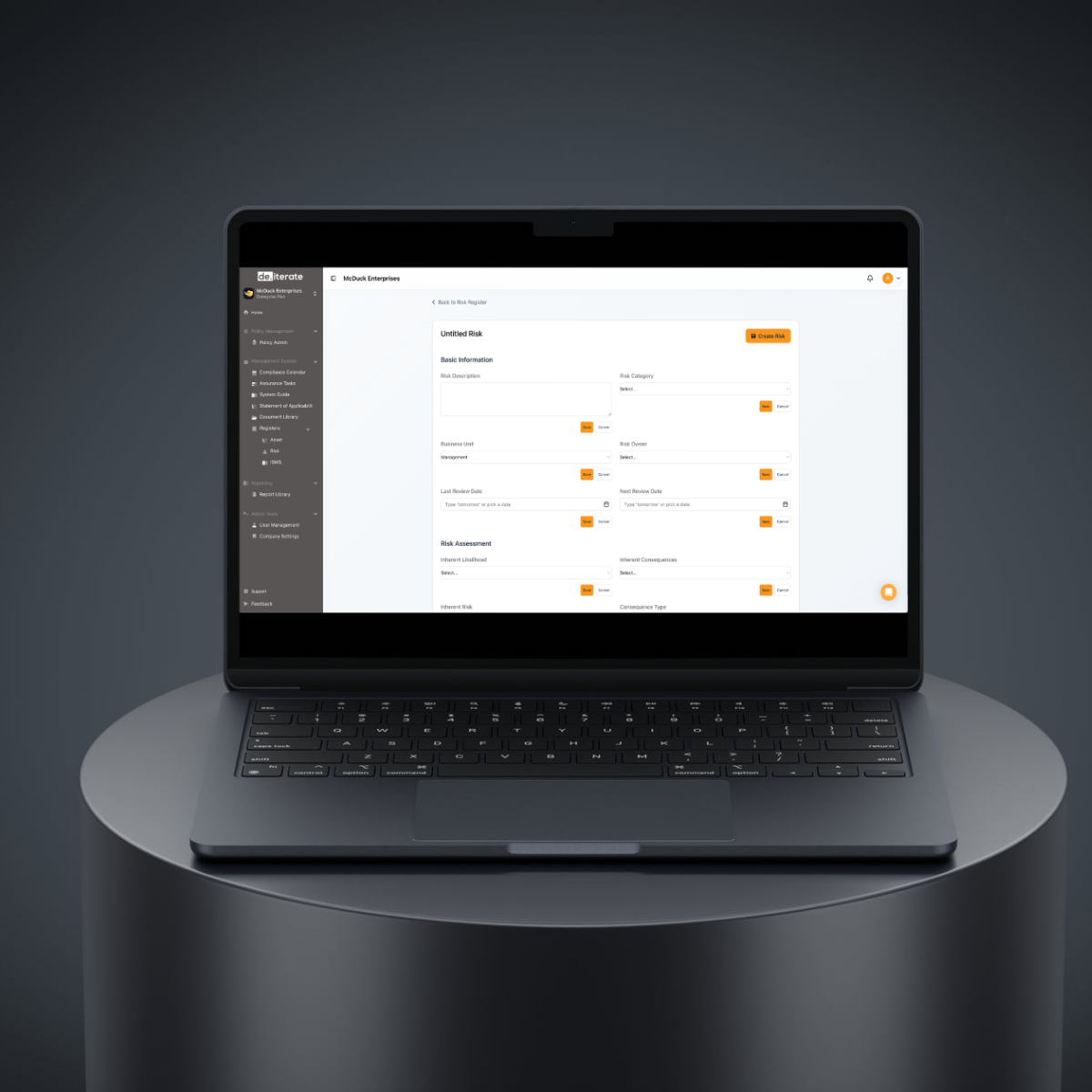
de.iterate is an Australian GRC platform with AI governance and ISO 42001 support built in. AI arrived in most businesses through browser tabs and feature updates. de.iterate helps you monitor and manage your AI risk using a management system that keeps up with your AI use cases.
Built on top of International AI frameworks, your de.iterate system can help with AI impact assessments, AI risk management, AI supply chain management and even dynamically monitor and report your AI risk metrics through the de.iterate fabric using automated key risk indicators.
de.iterate is certified to ISO 42001 through a JAS-ANZ accredited certification body, and was named GRC Provider of the Year at the 2026 Australian Cyber Awards.
We help you get your ducks in a row.
The AI nobody mentioned
Leadership knows about the official AI project, the one with a business case. Marketing is using three AI writing tools. Finance is trialling an AI add-on for reconciliations. A developer has been pasting code into a chatbot since March.
Larger organisations have an AI steering committee, an AI policy and a register with twelve approved use cases in it. The committee reviews the projects with a business case. Meanwhile, the CRM vendor switched on an AI assistant in the last release, the HR platform is screening applications with a model nobody evaluated, Copilot was enabled for 4,000 staff by a licensing decision rather than a governance one, and every SaaS tool procurement approved in 2023 has added features procurement never saw. The register is accurate for the AI the organisation chose. It says nothing about the AI the organisation was given.
“Who is responsible for AI?” is now a standard audit question. “Good question” is not a passing answer.
AI governance works when you know which AI systems you have, including the ones your vendors switched on, someone is accountable for each, and the controls around them grow out of the security and privacy work you’ve already done rather than starting a third program from scratch. de.iterate is built that way. AI systems sit in de.iterate's register that links to your suppliers and risks, impact assessments and approvals are recorded against each one, and the AI management system shares its controls and testing with ISO 27001 and privacy, so “who is responsible for AI?” has an answer with a name on it.
Build your AI management system with ISO foundations and map it to international standards and obligations. AI control design and testing are shared with your existing ISO 27001 and privacy programs, so your AI risk management naturally develops out of the foundations you already have.
Record your AI systems in de.iterate's configurable register, with the fields your AI management system needs. AI tools that touch your data cross-link with your de.iterate supplier registers, where you can note where the data goes and link each tool to your AI risks and controls.
Every automated suggestion in de.iterate arrives as a draft, with its reasoning and confidence stored alongside it. A human approves it before anything changes, which is the same kind of oversight management asks of you.
Each entry in the AI register carries an accountable owner, a business purpose and a review date, with roles mapped to the responsibilities ISO 42001 expects. When an auditor asks who is responsible for AI, the answer is a list of named people rather than a committee.
Start from an AI acceptable use policy written by de.iterate's GRC experts. Distribute it through de.iterate's policy module, track who has read it, and reset attestation when the rules change, so the developer pasting code into a chatbot has seen the policy that says not to.
Assess the impact of each AI system on people and on your organisation, and keep a record of the risks, decisions, controls and approvals that follow, as well as the evidence that each step took place.
Most questions about AI governance come down to two things: how much of this applies to an organisation that uses AI rather than builds it, and what an auditor will actually ask for. The answers below cover both, along with how de.iterate’s own AI treats your data, which is a fair thing to ask of a platform that governs AI.
ISO 42001 applies to organisations that develop, provide or use AI. Whether to certify is a business decision, but an AI policy, an inventory of AI tools and an AI risk assessment are worth having either way. They'll also help at your next ISO 27001 audit.
Auditors are looking for evidence across your data, suppliers, risks, controls, policies and training. A good start is an inventory of the AI in use, AI tools on your supplier register, an AI policy with some automated risk monitoring and a named owner for AI risk.
Every AI suggestion is a draft that a person approves, with the reasoning recorded. Your data is hosted in the jurisdiction you choose, Australia or the EU. Our Responsible AI statement has the details.
An AI management system is the set of policies, processes and objectives an organisation uses to develop, provide or use AI responsibly. ISO 42001 sets out the requirements for one.
Yes. The EU AI Act framework is built into de.iterate, so you can map its obligations alongside ISO 42001 and your other frameworks.
Start by reviewing critical business processes, then check them against your supply-chain inventory. Record what you find in de.iterate, and add data types in use to your data register. Map everything using the de.iterate fabric and gain instant visibility into your risk surface. Our blog post Shadow AI: How to Find the AI Already in Your Business has more tips.
Yes. de.iterate is certified to ISO 42001 through a JAS-ANZ accredited certification body.
From setup to scale, every feature is designed to help your team save time, stay focused, and drive meaningful results.
de.iterate combines technology with hands-on support from experienced GRC professionals based in Australia. From onboarding through to certification, our team works with you to build momentum quickly, helping many organisations get audit-ready in less than 12 weeks and providing practical support through external audits and ongoing compliance activities.
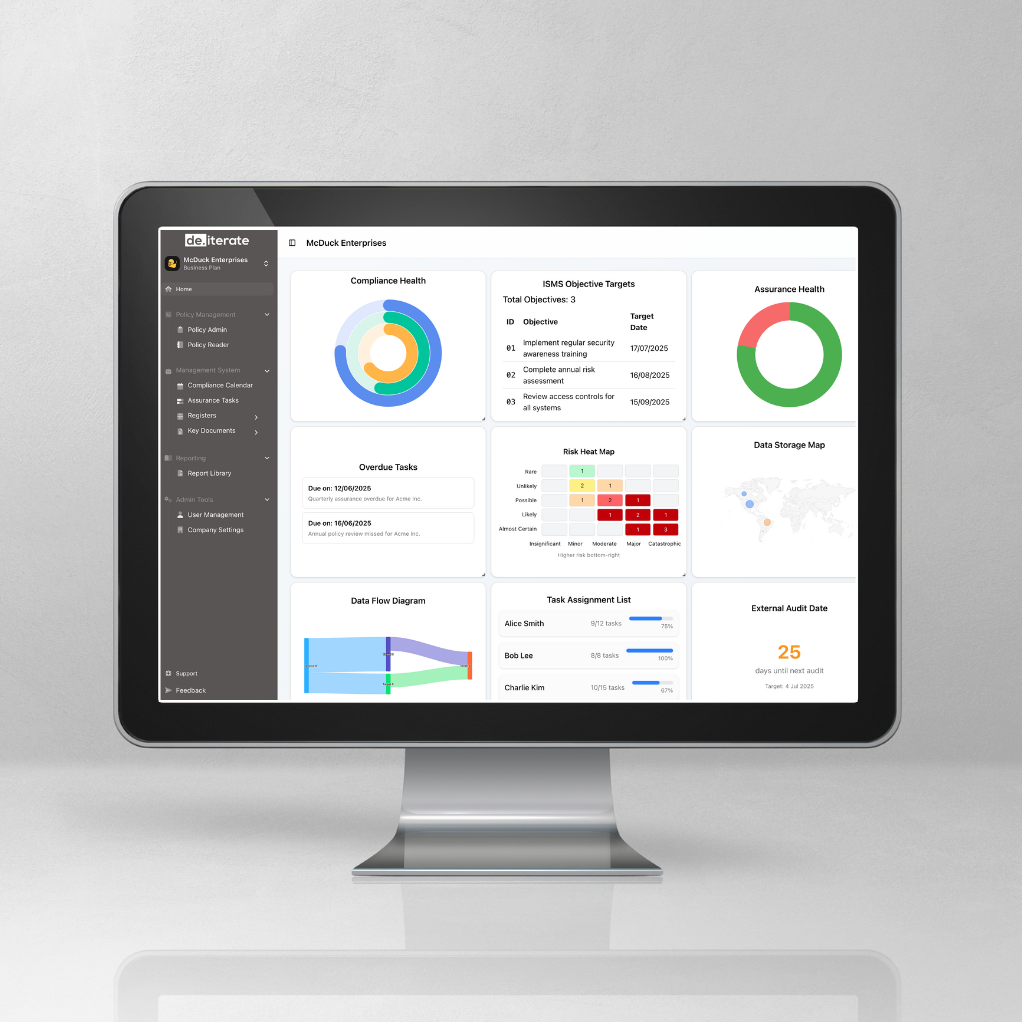
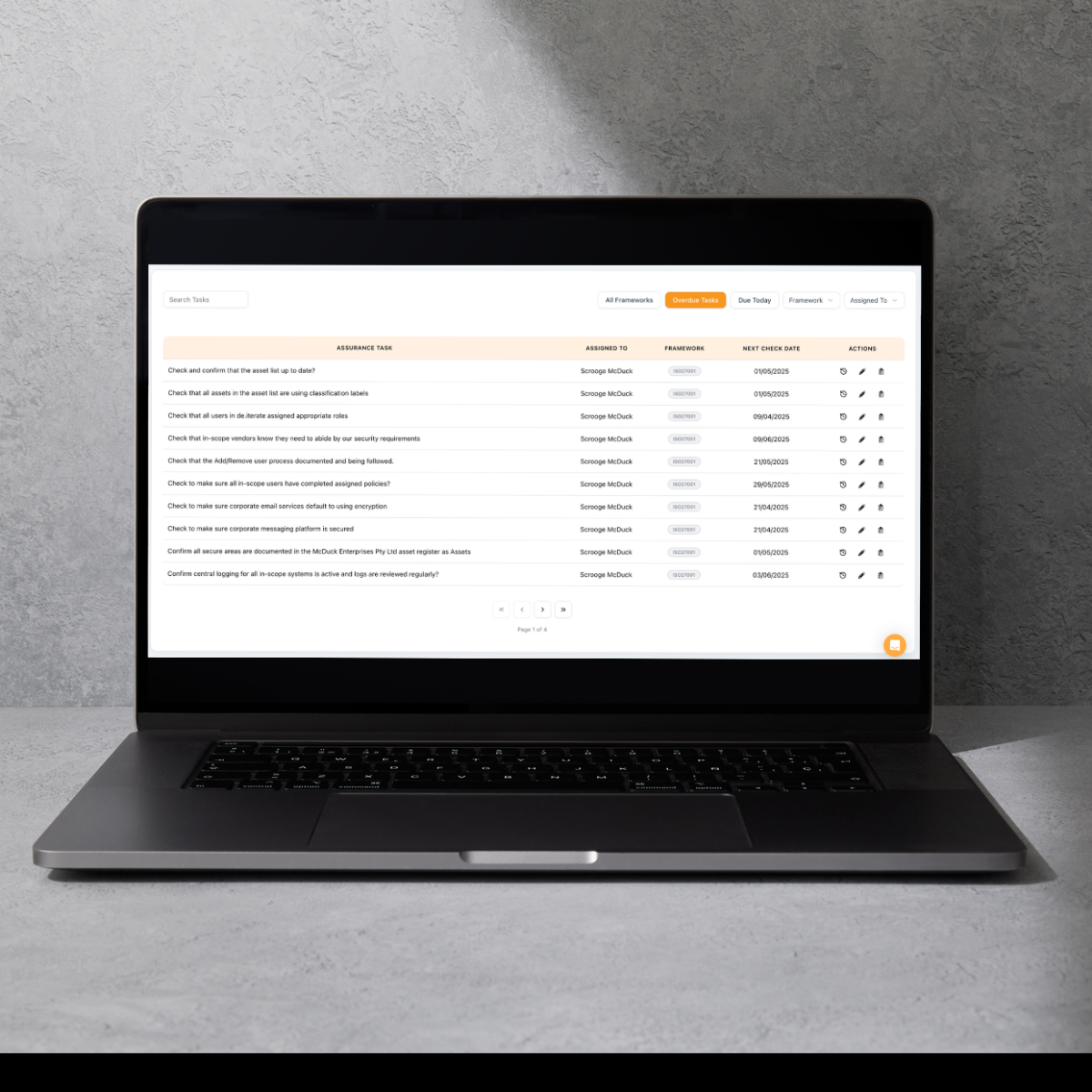
Great compliance is not built in the two weeks before an audit. de.iterate helps you stay ready year-round with assurance tasks, checklists, live registers, reporting and a compliance calendar that keeps momentum going.
From start-ups to enterprise, de.iterate supports multiple frameworks in one system, including ISO 27001, ISO 27701, ISO 9001, ISO 14001, ISO 45001, Privacy Acts, SOC 2, DIP, Essential Eight and more. You can grow your compliance maturity without rebuilding everything from scratch.
Many tools stop at storage. de.iterate goes further by connecting your policies, controls, evidence, registers and assurance activity in context. That means your documentation is not just centralised, it is structured, linked and easier to defend.
We believe compliance should be simpler, clearer and more achievable. That is why de.iterate combines structured workflows, smart documentation, migration support and guided onboarding with a platform that is intuitive enough for teams to use every day.
de.iterate is designed for the way organisations actually work. Policies, risks, assets, incidents, suppliers, evidence, audits and reporting all sit in one integrated platform, so compliance becomes part of business as usual.
A risk register with a pulse, with inherent and residual scoring, heatmaps and risk appetite.
Every obligation traced to the evidence that meets it, across 25+ frameworks.
Plain-English policies, clear approvals and proof your staff have read them.
Scheduled controls testing, with the evidence ready before your auditor asks.
Find your personal information, see where it goes and keep your privacy policy current.
ISO 9001, ISO 14001 and ISO 45001, running alongside everything else you manage.

With de.iterate, the complexity of managing multiple frameworks doesn’t translate into increased workload. Our unified platform serves as a central hub for overseeing all your compliance activities, whether you’re working with bespoke frameworks or seeking to meet the criteria of the most sought-after security and privacy standards and certifications.
The global standard for building EMS. It gives you a structure to identify environmental impacts, manage obligations, strengthen governance.
This standard specifies the requirements for managing AI systems responsibly and ethically. It helps ensure trustworthy development and use of AI.
This specifies how organisations should manage their customer’s data. It is one of the most sought-after security framework for SaaS companies.
Country-specific legislative frameworks established to protect individuals’ personal information from misuse, interference, unauthorised access, modification, and disclosure.
The Australian Government’s Department of Employment and Workplace Relations uses the External Systems Accreditation Framework and the RFFR approach to assess and accredit third party service providers and systems.
DISP is a critical initiative that ensures businesses in the defence supply chain meet stringent security requirements. DISP compliance is essential for companies that engage in Defence tenders, contracts and projects.
de.iterate pricing is structured around the compliance frameworks you choose to access, giving you the flexibility to build a program that fits your organisation’s needs. Every plan includes access to the de.iterate platform and its feature set, from automated and expert-led onboarding, through to migration support, assurance workflows, live registers, compliance reporting and the core documentation needed to run and maintain your management system with confidence.
Essential Eight
SMB 1001
Privacy Acts
DISP
Cyber Essentials
ISO 27001
ISO 27701
ISO 42001
ISO 9001
ISO 45001
ISO 14001
SOC 2
NIST CSF 2.0
NIST 800-53
NIST 800-172
NIST 800-172
GDPR
Essential Eight
SMB 1001
Privacy Acts
DISP
Cyber Essentials
DORA
NIS2
CIS v8
EU AI Act
TISAX
ISO 27001
ISO 27701
ISO 42001
ISO 9001
ISO 45001
ISO 14001
SOC 2
NIST CSF 2.0
NIST 800-53
NIST 800-171
NIST 800-172
GDPR
Essential Eight
SMB 1001
Privacy Acts
DISP
ISM
SOCI
Right Fit for Risk (RFFR)
Cyber Essentials
DORA
NIS2
CIS c8
EU AI Act
TISAX
Start with the free AI risk assessment, or see how de.iterate supports ISO 42001.