

Compliance Can’t Live in One Person’s Head
As artificial intelligence (AI) continues to reshape industries, businesses are facing new risks – from data security concerns to ethical AI governance. Managing these risks effectively requires a structured, standards-based approach. That’s where ISO 42001 and ISO 27001 come in.
By integrating ISO 42001 (AI Management System) and ISO 27001 (Information Security Management System), organisations can establish a holistic risk management framework that addresses both AI-specific challenges and broader cyber security concerns.
Understanding ISO 42001 and ISO 27001
ISO 42001: AI Risk Management and Governance
ISO 42001 is the first international standard for AI management systems, helping organisations govern, monitor, and mitigate risks associated with AI technologies. It provides a structured framework for:
- Ethical AI principles and bias mitigation
- AI model transparency and accountability
- Compliance with evolving regulations (e.g., AI Act, Privacy Acts)
- Risk assessments for AI-powered decision-making
As businesses increasingly integrate AI into their operations, adopting ISO 42001 ensures responsible and secure AI development and application.
ISO 27001: Information Security and Cyber Resilience
ISO 27001 remains the gold standard for information security management, helping organisations:
- Protect sensitive data from cyber threats
- Implement access controls, encryption, and monitoring
- Reduce the risk of data breaches, ransomware, and insider threats
- Ensure regulatory compliance with GDPR, the Australian Privacy Act, and more
While ISO 27001 strengthens cyber security, it does not specifically address AI risks—which is why integrating both standards is critical for comprehensive risk management.
Why Integrating ISO 42001 and ISO 27001 Matters
With AI increasingly handling sensitive data, automating decisions, and influencing business operations, organisations need a unified approach to risk management. Integrating ISO 42001 and ISO 27001 allows businesses to:
Align AI governance with established security protocols – Ensuring AI systems follow the same stringent security measures as other business-critical technologies.
Mitigate AI-related data risks – Protecting personal data, intellectual property, and sensitive business information from AI-driven vulnerabilities.
Meet compliance requirements efficiently – Streamlining audits and reporting for both AI and cyber security frameworks, avoiding duplicated effort.
Enhance stakeholder trust – Demonstrating proactive AI governance and robust security builds confidence with regulators, partners, and customers.
How de.iterate Simplifies Compliance
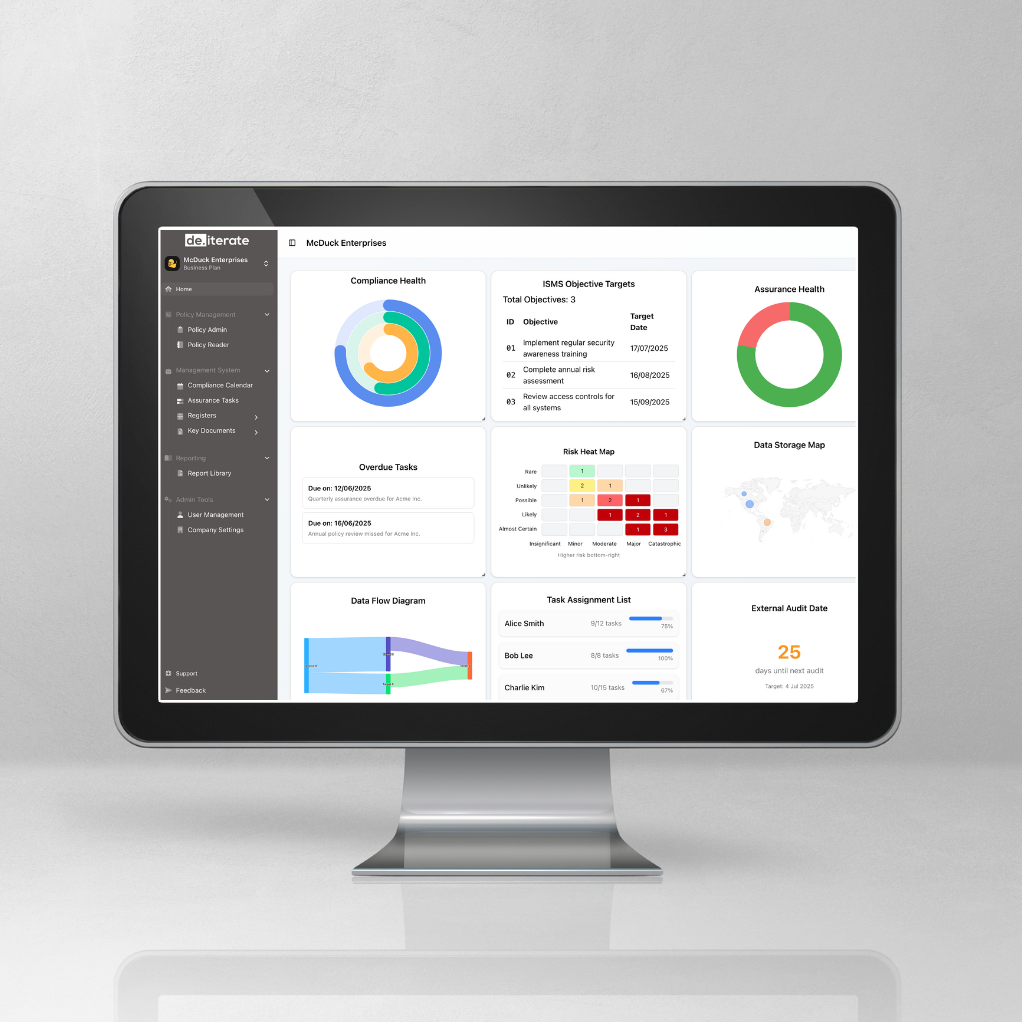
Managing multiple compliance frameworks doesn’t have to be overwhelming. At de.iterate, we help organisations integrate ISO 42001, ISO 27001, and other security frameworks into a seamless, efficient compliance strategy. Our platform:
- Centralises risk management – making it easier to track compliance for AI and security frameworks in one place.
- Reduces complexity – automating workflows, risk assessments, and documentation to streamline certification processes.
- Eliminates duplicate effort – aligning controls across multiple frameworks, ensuring a cohesive, time-saving approach to compliance.
Whether your organisation is implementing AI governance for the first time or strengthening existing security measures, de.iterate provides the tools and expertise to simplify compliance.
Future-Proofing Your Business with AI & Cyber Security Compliance
AI and cyber security risks are evolving, and so too must your approach to risk management and compliance. By integrating ISO 42001 and ISO 27001, organisations can build a resilient, future-ready security framework that safeguards both AI-driven systems and critical business data.
Looking to integrate ISO 42001 and ISO 27001 seamlessly? Get in touch with de.iterate today, and we can simplify your compliance together.
Tags: