

Compliance Can’t Live in One Person’s Head
Let’s be honest: when most founders hear the words ISO 27001, their eyes glaze over faster than a Krispy Kreme donut. And fair enough. Traditional information security management systems (ISMS) conjure images of binders, beige policies, and a level of bureaucracy that would make even the ATO blush.
But here’s the twist most startups don’t realise: ISO 27001 doesn’t have to turn you into a paperwork factory. In fact, when done right, an ISMS can actually make your startup faster, safer, and more trustworthy, without killing innovation or forcing your devs into early retirement.
So, if you’re scaling fast, landing enterprise customers, or simply trying to avoid future you cursing present you, this guide is for you. Let’s demystify how a startup can build an ISO 27001–aligned ISMS without becoming a bureaucracy.
Why Startups Think ISO 27001 Will Destroy Their Soul
Startups live and breathe speed, flexibility, autonomy and minimal process. It’s that “let’s just ship it and fix it later” energy. And unlike established enterprises, most early-stage teams don’t have the spare cycles for six months of documentation and process engineering.
So the fear makes sense: you worry ISO 27001 will drown your culture in forms no one reads, processes no one follows, meetings no one asked for, and policies written like they’re auditioning for a law firm.
But here’s the truth: ISO 27001 doesn’t ask you to be a bureaucracy. It actually asks you to be intentional. It’s about putting enough structure in place so you don’t fall apart when something goes wrong.
The ISMS Mindset Shift: Minimum Viable Bureaucracy
Think of an ISMS the same way you think of product development: build a Minimum Viable System first, then iterate. You don’t need 90-page policies. You don’t need 40 controls implemented on day one. You don’t need committees, councils, or conference rooms named after planets.
What you do need is:
1. Clear responsibilities: Who owns security? (Hint: “everyone” is not an answer.)
2. A simple risk process: Not a PhD thesis. Just a way to identify what could go wrong and what you’ll do about it.
3. Lightweight policies people actually understand: Short, actionable, written in human language.
4. Basic controls that already align with what you’re doing: Startups are often more secure than they think. They just don’t document it.
5. Evidence as you go: Not a panic-driven scramble when the auditor arrives.
You don’t need to build a corporate fortress. You just need a functioning seatbelt system.
The Big Mistake Startups Make (Spoiler: They Overbuild)
Most startups assume that to get certified, they need:
- Enterprise-level processes
- Enterprise-level documentation
- Enterprise-level tools
- Enterprise-level staff
Nope.
ISO 27001 is proportionate, meaning your controls and documentation should match your size, risk, and complexity. If you’re a 15-person SaaS company, you shouldn’t be writing policies like a Big Four bank.
Overbuilding is the fastest path to frustrated teams, inconsistent processes, policy bloat, and a compliance system that no one wants to maintain.
Lean > large. Always.
What an ISO 27001-Friendly Startup Actually Looks Like
Here’s the good news: a lot of what startups already do maps neatly to ISO 27001. You just haven’t labelled it yet.
You already use MFA everywhere. Congrats — that’s Annex A.5.17 sorted.
You control access to customer data. Nice. That’s identity and access management.
You use cloud-native logging and monitoring. Perfect fit for A.5.7.
You keep architecture diagrams updated. That’s asset management and system planning.
You run incident reviews like blameless post-mortems. That’s continual improvement.
You use ticketing systems for change management. You’re halfway to A.8.32 without knowing it.
Startups often think ISO means reinventing the wheel. But for most, it’s about naming the wheel, describing the wheel, and occasionally checking the wheel still works.
The Secret: Keep It Embedded, Not Added-On
If your ISMS sits in a dusty folder or a compliance platform no one opens except once a year, you’re doing it wrong.
Great startup ISMSs are:
- Built into existing tools (Jira, Notion, Slack, GitHub)
- Based on real working habits
- Automated where possible
- Scalable as the business grows
- Focused on behaviour, not documents
The best ISMS feels invisible because it’s woven in, not bolted on.
How de.iterate Helps Startups Stay Fast and Compliant
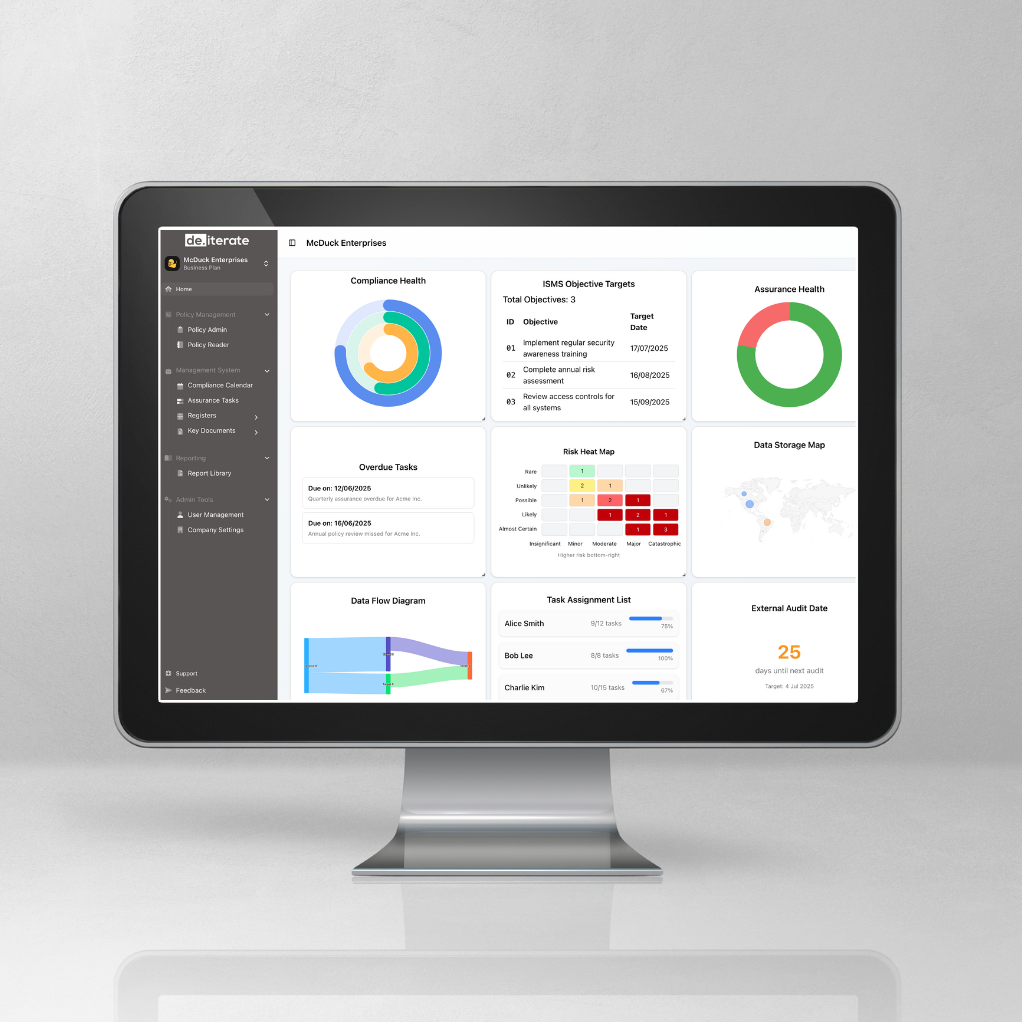
This is exactly why de.iterate exists: to help modern, growing companies build and maintain ISO 27001 compliance without turning into mini-bureaucracies.
We help startups: build lean, right-sized policies, map what they’re already doing into ISO controls, automate evidence collection, reduce compliance overhead, keep everything continuously updated (not panic-updated once a year), and scale security maturity as the business grows.
ISO 27001 Doesn’t Slow Startups
When done properly, ISO 27001:
- Wins enterprise deals
- Builds trust
- Reduces security risk
- Improves engineering discipline
- Prevents future chaos
- Makes audits painless
- Supports long-term scale
The trick isn’t avoiding ISO. It’s avoiding the bloated, box-ticking version of ISO that drains energy and enthusiasm.
Start small. Build smart. Embed everything. Before you know it, you’ll have a powerful, lightweight ISMS, and the certification to match.
Tags: