

Compliance Can’t Live in One Person’s Head
Your supplier list is not just a list of vendors. It’s a map of where your business has handed part of its risk to someone else.
That might sound dramatic, but think about how many third parties are now sitting inside the average organisation’s operating model. There are cloud hosting providers, payroll platforms, CRM systems, managed service providers, AI tools, and marketing platforms, not to mention consultants and support partners. The list grows quickly.
Every one of those suppliers may have some relationship with your systems, your data, your customers, your operations, or your reputation.
That is why ISO 27001 Control 5.19 – Information Security in Supplier Relationships exists. It is there to make sure organisations do not treat suppliers as if they sit outside the security boundary. Because they don’t. If a supplier stores your data, processes your information, supports your systems, manages your infrastructure or affects your service delivery, they are part of your risk posture.
In plain English: supplier risk is still your risk. “We sent them a questionnaire once” is not a supplier security strategy.
What Control 5.19 is Actually Asking
Control 5.19 requires organisations to define and implement processes and procedures to manage information security risks associated with supplier products or services. Super ISO sounding definition, right?!
What it really means is this: before you rely on a supplier, you need to understand the risk they introduce, set expectations, manage the relationship, and keep reviewing it over time. This control is not focused just on the procurement phase, or initial contracts; it extends across the entire lifecycle of your supplier relationships.
Your supplier relationships need to be managed in a way that protects your information, systems and business operations, including understanding:
- who your suppliers are
- what services they provide
- what information they access, process or store
- which systems or business processes they support
- what security expectations apply
- who owns the relationship internally
- how supplier risks are assessed and reviewed
- what happens when the supplier changes, fails, or is no longer used
What Control 5.19 is really asking is whether your organisation has a real supplier security process, not just a folder full of vendor contracts.
Why Supplier Risk Matters
Most organisations are more dependent on suppliers than they realise. Your customer data may sit in a SaaS platform. Your MSP may manage backups or endpoint security. Your payroll provider may hold sensitive employee information. Your AI tools may process business data in ways that were not happening six months ago.
The problem is that supplier risk often grows quietly. A small tool might be approved because a team needs it quickly. A contractor gets access to a system for a project. A vendor adds a new AI feature. A cloud service becomes business-critical. A platform starts handling more sensitive data than originally intended.
Before long, the supplier register is out of date, the risk assessment no longer reflects reality, and no one is completely sure who owns the relationship. Without a structured supplier security process, organisations risk:
- giving suppliers access without proper review
- failing to understand where sensitive data is being processed
- missing contractual security requirements
- relying on suppliers with weak controls
- overlooking fourth-party and sub-processor risk
- failing to review suppliers after onboarding
- struggling to respond when a supplier has an incident
- being unable to prove supplier oversight to customers or auditors
Supplier risk matters because your customers do not care whether the weak link was technically “your supplier”. If your data is exposed, your service fails, or your compliance position collapses, it becomes your problem very quickly.
Where Organisations Usually Get This Wrong
Most organisations do not ignore suppliers completely. The problem is usually more subtle.
They do something at the start, then forget to manage the relationship properly afterwards.
Common patterns include:
- a supplier assessment is completed once, then never reviewed
- procurement owns the contract, IT owns the system, and compliance owns the audit question, but nobody owns the risk
- suppliers are all treated the same, whether they provide office stationery or host customer data
- security requirements are not clearly reflected in agreements
- supplier access is not reviewed when roles, systems or services change
- business-critical suppliers are not identified as critical
- sub-processors and fourth parties are ignored
- supplier evidence is stored in inboxes, shared drives or old questionnaire files
- offboarding is an afterthought
A particularly common trap is assuming that a big supplier must be safe because they are big. That is brand-based optimism, rather than risk management. Large suppliers can still introduce risk, and small suppliers can still have strong controls. The main thing is to understand the relationship, assess the risk and manage it proportionately.
What Good Looks Like
A mature approach to supplier relationships is not about burying every vendor under a 200-question security assessment. It is about applying the right level of governance to the right relationship. Good supplier security usually includes the following.
1. A live supplier register
The organisation knows who its suppliers are, what they provide, who owns the relationship, and whether they touch information, systems, customers or critical operations.
Their supplier register is live and reflects the business as it operates today, rather than a spreadsheet gathering dust in SharePoint.
2. Risk-based supplier assessment
Not every supplier needs the same level of review. A supplier handling sensitive customer data needs more scrutiny than a supplier delivering office furniture. A business-critical SaaS platform needs more attention than a low-risk marketing tool. Good supplier governance applies proportionate assessment based on data sensitivity, operational dependency, access, criticality and compliance impact.
3. Clear internal ownership
Every important supplier should have a specific, relevant business owner. Blanket owners like ‘IT’ or ‘the compliance team’ are not sufficient. Owners should be real people, or real roles, that are accountable for making sure the supplier relationship is understood and regularly reviewed.
4. Security requirements in agreements
Supplier agreements should reflect the security expectations that actually matter. Depending on the relationship, that may include confidentiality, access control, incident notification, data handling, sub-processor disclosure, audit rights, service continuity, security certifications, breach notification and exit obligations.
5. Review and monitoring
High-risk suppliers should be reviewed periodically.
That might involve checking updated certifications, reviewing security questionnaires, confirming access, checking contract changes, reviewing incidents, or reassessing whether the supplier is still appropriate for the role they play.
Supplier assurance should not only happen when a customer asks.
6. Evidence that tells the story
If an auditor or customer asks how supplier risk is managed, the organisation should be able to show:
- the supplier register
- the risk assessment
- the owner
- the controls or requirements
- the supporting evidence
- the review history
- any actions or treatment plans
This is where many organisations fall down. They might have done parts of the work, but the evidence is scattered and hard to connect.
Common Pitfalls
Control 5.19 can look mature on paper while failing in practice. Some of the most common mistakes include:
- keeping a supplier list but not assessing risk
- assessing suppliers but not assigning owners
- collecting questionnaires but not reviewing the answers
- treating supplier assurance as a procurement task only
- failing to update supplier risk when services change
- ignoring suppliers used by individual teams
- forgetting offboarding and access removal
- failing to connect suppliers to data, assets and controls
- storing evidence in inboxes or old folders
- assuming supplier certifications are enough on their own
The biggest pitfall is treating supplier management as an onboarding activity. It is not. It is an ongoing risk management process.
How de.iterate Helps
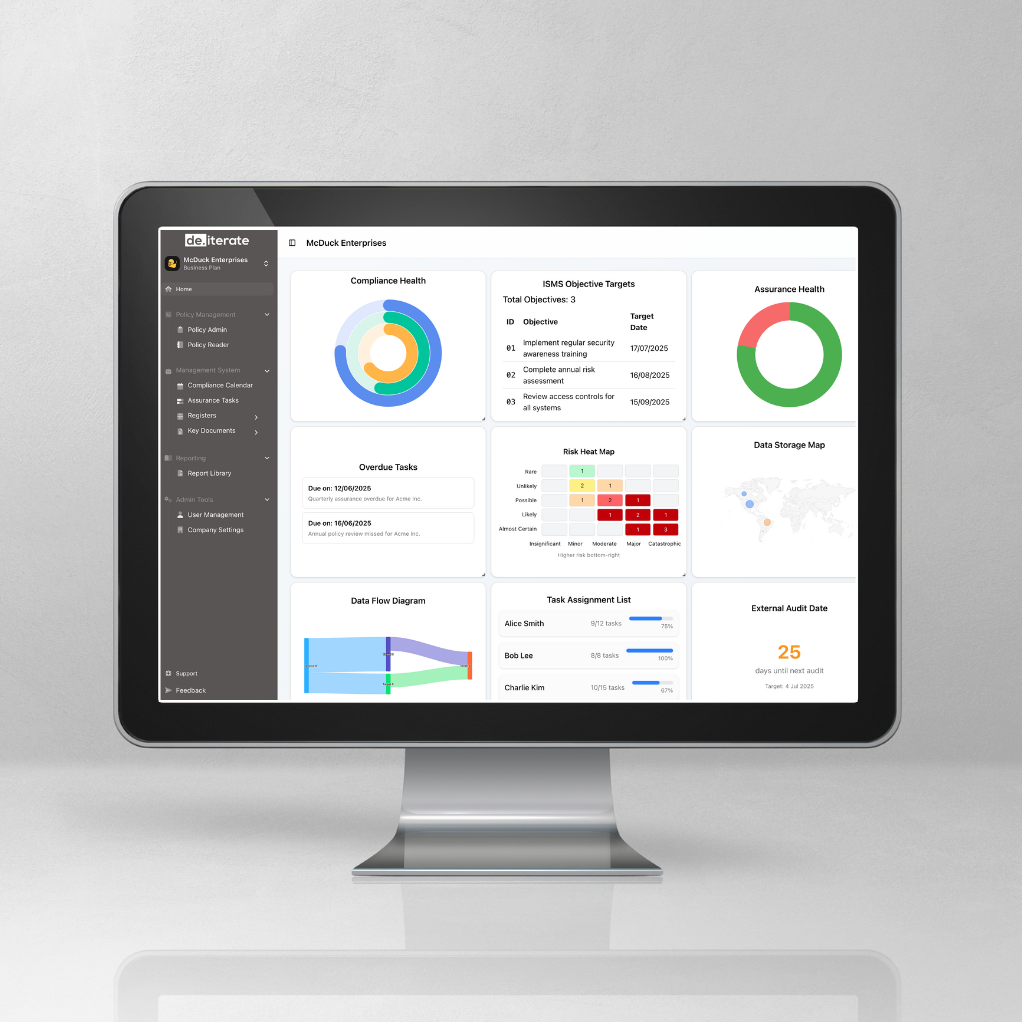
At de.iterate, we help organisations make supplier risk visible, connected and manageable. Our platform supports you to:
- maintain a live supplier register
- assign supplier owners and responsibilities
- document supplier risk and criticality
- connect suppliers to assets, data, risks, controls and policies
- schedule recurring supplier reviews through assurance tasks
- capture evidence against supplier controls and obligations
- track actions, gaps and treatment plans
- support audit and customer assurance requests
- show how supplier risk fits into the wider management system
Instead of supplier information living in spreadsheets, procurement folders, email threads or someone’s head, it becomes part of your operating governance program. That matters because suppliers are not separate from your risk environment. They are part of it.
When supplier governance is connected properly, it supports more than ISO 27001. It also helps with privacy, AI governance, customer assurance, operational resilience and broader risk management.
Book a demo to see how it works.
Tags: