
One Internal Audit, Four Standards: How Integrated Management Systems Actually Work
Moving to the cloud didn't get rid of your infrastructure. It moved it somewhere you can't see, run by people you've never met, under terms you probably agreed to with a single click.
Most organisations now run on cloud services: email, file storage, CRM, finance, HR, ticketing, code repositories, hosting and, increasingly, AI tools. Plenty of them were signed up for by a team lead with a credit card rather than through any kind of approval process.
That's why ISO 27001 Control 5.23 – Information Security for Use of Cloud Services exists. It was one of the new controls added in the 2022 revision of the standard. It fills a gap the old version never quite addressed: how you choose, use, manage and eventually leave cloud services, securely.
In plain English: the cloud may be someone else's computer, but it's still your data, your obligations and your risk.
What Control 5.23 is Actually Asking
Control 5.23 requires organisations to set up processes for acquiring, using, managing and exiting cloud services, in line with their own information security requirements.
Look closely at those four verbs. This isn't just a procurement control, or just an IT control. It covers the whole lifecycle:
- Acquisition: how cloud services are chosen and approved, and what security requirements they must meet before anyone signs up
- Use: how they're configured, who has access, and what information can be stored in them
- Management: how you monitor them, keep up with changes the provider makes, and review them over time
- Exit: how you get your data back out, and confirm it's deleted, when the relationship ends
The supporting guidance in ISO 27002 goes further. It expects you to understand how security responsibilities are split between you and the provider. It also recognises that standard cloud terms often can't be negotiated, so you need to assess them anyway, and plan for what happens if the provider changes its service or disappears.
What 5.23 is really asking is whether you know which cloud services you rely on, and whether you're managing them on purpose rather than by default.
Why It Matters
Cloud services now hold most of the information ISO 27001 asks you to protect. Yet a new SaaS tool often gets less scrutiny than a new laptop.
Without a deliberate approach, organisations risk:
- sensitive data sitting in services nobody approved
- misconfigured storage or sharing settings exposing information to the internet
- assuming the provider handles security that is actually their own job
- data stored in locations that conflict with privacy obligations or customer contracts
- being locked into a provider with no realistic way out
- missing it when a provider changes its terms, adds subprocessors or switches on new features
That last one has become far more pressing. SaaS providers are shipping AI features into existing products, often switched on by default. The tool you assessed two years ago may now be processing your data in ways that didn't exist when you signed up.
Nothing changed on your side, but your risk did.
Where Organisations Usually Get This Wrong
Common patterns include:
- the cloud inventory covers the big platforms but misses the long tail of SaaS tools
- security is assessed once, at sign-up, and never again
- nobody has read the provider's shared responsibility model
- configuration is left at the vendor's defaults
- admin access sits with whoever set the tool up, including people who have since left
- there's no exit plan until the day one is needed
If you read our post on Control 5.19, some of this will sound familiar. 5.19 covers supplier relationships in general. 5.23 zooms in on cloud specifically, because cloud is bought and used differently. You rarely negotiate the contract, you configure much of the security yourself, and switching providers is harder than it looks.
The Shared Responsibility Myth
"It's in the cloud, so the provider handles security" is one of the most common assumptions in compliance. It's also one of the most expensive.
Every major cloud provider publishes a shared responsibility model. The provider secures the underlying platform. You're responsible for what you put on it and how you set it up: identities and access, configuration, data classification, how the service is used and, in many SaaS products, your own backups.
Many cloud incidents don't start with the provider being breached. They start with a storage bucket left public, an admin account without MFA, or an integration with far more permissions than it needed. Those are customer-side failures, and auditors know it.
Your provider's ISO 27001 certificate or SOC 2 report is useful evidence. But it covers their side of the line, not yours.
What Good Looks Like
Good cloud governance doesn't mean a six-week approval process for a whiteboard app. It means effort matched to risk, and decisions made on purpose.
1. A Cloud Services Inventory
Every cloud service in use, what it's for, who owns it, what information it holds and how sensitive that is, and where the data is stored. That includes the long tail of SaaS and the AI tools people are already using. You can't manage a service you don't know about.
2. Requirements Set Before Sign-Up
A lightweight approval step, scaled to the risk. Minimum requirements might cover single sign-on and MFA, encryption, data location, certifications, subprocessor transparency and exit terms. A design tool holding marketing images doesn't need the same 200-question review as the platform holding your customer records.
3. Responsibilities Mapped
For each critical service, write down what the provider is responsible for and what you are. It takes an hour, and it removes the most dangerous assumption in cloud security.
4. Secure Configuration
Settings are reviewed against a baseline, not left at vendor defaults. Admin accounts are limited, named and reviewed. Integrations and API connections get the same scrutiny as user access.
5. Ongoing Provider Monitoring
Provider certifications and assurance reports are reviewed every year. Someone keeps an eye on change notices, new subprocessors, new AI features and security incidents, and the outcome is recorded. This is a recurring task, not a one-off.
6. An Exit Strategy
For critical services, you know how to get your data out, in what format and how long it takes, how deletion will be confirmed, and what you'd move to instead. For the most critical services, the export has actually been tested. Leaving a provider shouldn't be the first time you find out your data comes back as 4,000 unreadable files.
What an Auditor is Likely to Look For
- A documented approach covering how cloud services are acquired, used, managed and exited
- A current inventory of cloud services, each with an owner
- Evidence that security requirements were assessed before a service was adopted
- A clear understanding of shared responsibility for key services
- Evidence of periodic review, such as provider certifications or SOC 2 reports checked and recorded
- Exit plans for critical services
- Consistency between your cloud inventory, supplier register, risk register and Statement of Applicability
Expect the auditor to pick a cloud service at random, often one you'd forgotten about, and ask you to walk them through it. As with every control in this series, they're less interested in the policy than in whether it's actually operating.
The Five-Minute Test
Pick the cloud service that holds your most sensitive customer data. Then ask four questions:
- Who approved it, and what was checked?
- Who has admin access today?
- Where is the data actually stored?
- If you had to leave next month, how would you get the data back, and how would you know it had been deleted?
If those answers come back quickly and consistently, 5.23 is working.
If the answer is "IT would know," you have a dependency, not a control.
Need Help Getting Your Ducks in a Row?
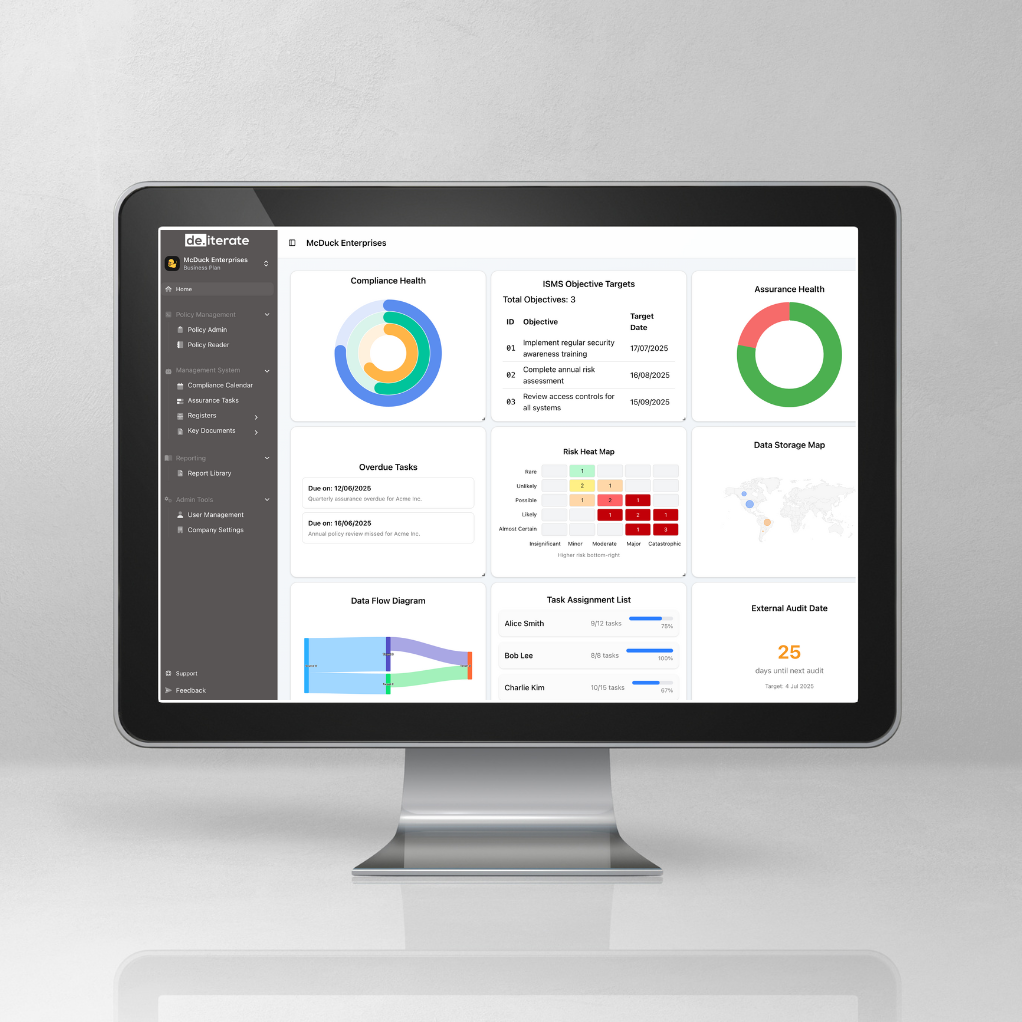
de.iterate helps you manage cloud services as part of your ISMS, not alongside it. Record every cloud provider in your supplier register with an owner, the data it holds and where that data lives. See your data flows and storage locations on a single map. Build cloud security questionnaires mapped straight to Control 5.23, schedule annual provider reviews as recurring assurance tasks, and keep the evidence ready for your auditor.
So cloud governance becomes something you can manage, maintain and prove, rather than something you hope is happening.
Tags: