This time last year, we wrote about why scammers love the festive season. Fake parcel texts, too-good-to-be-true deals, invoice scams timed for when finance is half on leave. A year on, the Christmas lights are back up, Black Friday lands on 27 November, Cyber Monday on 30 November, and the scammers have had twelve months to practise.
Some things have changed. The scams look more convincing, because AI is now doing a lot of the writing and web design. Some haven't. The way scammers actually get in, whether you're a five-person business or a household name, is still overwhelmingly through gaps in the basics.
So this year's update has a slightly different message. Yes, watch out for dodgy links. But the real protection, for organisations of every size, is boring, daily, unglamorous security hygiene.
The Numbers Are Still Going the Wrong Way
The National Anti-Scam Centre's latest Targeting Scams report shows Australians lost $2.18 billion to scams in 2025, up 7.8% on 2024, even though the number of reports fell slightly. Fewer scams are being reported, but each one is costing more.
The festive season is when that pressure peaks. Australians often spend close to $7 billion over the pre-Christmas sales events, and scammers follow the money. According to the ACCC, buying-and-selling scams accounted for 58.7% of Scamwatch reports involving a financial loss in the first nine months of 2026.
For businesses, the number to watch is payment redirection: invoice and bank-detail fraud. It was the second-biggest scam category by losses in 2025, at $166.8 million. End-of-year is prime time for it. Finance teams are busy, approvers are on leave, and an email saying "we've changed our bank details" doesn't get the second look it deserves.
What's Different This Year
The classics are all still here: fake delivery texts, fake charities, fake travel deals. But a few things have levelled up since last Christmas.
- AI-built fake stores. The Australian Banking Association has warned that criminals are using AI to clone legitimate online stores, copying logos and product photos and pushing them into social media feeds. A polished website is no longer proof of anything.
- Phishing without the typos. Last year we told you to watch for poor grammar. That red flag is fading fast. AI writes clean, convincing, on-brand emails in seconds.
- Fake "prove you're human" prompts. Security firm Arctic Wolf is warning retailers about fake CAPTCHAs, browser errors and verification prompts that trick people into running malicious commands on their own computer, a technique known as ClickFix.
- AI shopping agents. The same report flags a newer risk: personal AI shopping agents that may approve payments to fraudulent sellers without the shopper realising.
The common thread? Scams are getting harder to spot by eye. Which means relying on people to spot them, on their own, is a weaker defence than it used to be.
Big Companies Get Scammed for the Same Reasons Small Ones Do
It's tempting to think major breaches involve elite hackers and zero-day exploits. Sometimes they do. More often, they start with something much more ordinary.
Some of the biggest incidents didn't start with a technical breakthrough. They started with a person being persuaded to do something, or a supplier with access to something that mattered.
That's the uncomfortable truth for every organisation, whatever its size. Big companies have bigger security budgets, but they also have more staff, more suppliers, more systems and more ways in. Small businesses have fewer of all of those, but often less time to look after them. Either way, attackers go looking for the same thing: the gap where the basics weren't done.
The good news is that the basics are within reach of every organisation. You don't need a 24/7 security operations centre to close them. You need consistency.
The Basics, Done Every Day
Anti-virus that's actually working. Every device that touches your systems needs modern endpoint protection: switched on, up to date and reporting back to someone who checks it. "We installed it once" doesn't count. The usual gaps are the laptop that hasn't connected in a month, the contractor's personal device, and the alert nobody reads.
Safe web browsing. Most scams arrive through a browser or an inbox. Keep browsers on automatic updates, control which extensions people can install, and use web filtering to block known-bad and newly registered domains. With fake CAPTCHAs and cloned stores now in play, make one rule clear: no legitimate website will ever ask you to paste a command into your computer to prove you're human.
Patching every day, not once a week. This is the one most organisations get wrong. The Australian Cyber Security Centre warns that once a vulnerability in an online service is made public, malicious code can be expected within 48 hours, sometimes within 24. Its Essential Eight guidance expects patches for critical vulnerabilities in online services to be applied within 48 hours of release.
Now do the maths. If you patch every Friday, a vulnerability disclosed on Saturday has almost a week to be exploited before you get to it. Attackers don't wait for your maintenance window. Your patching rhythm shouldn't either: check for updates daily, apply critical ones as soon as they're out, and don't let a December change freeze become a December exposure window.
We saw this play out recently with critical PHP vulnerabilities. The organisations that came through it well weren't the ones with the biggest budgets. They were the ones that knew what they were running and patched it fast.
Know Who Has Access to What
If M&S and Qantas teach us anything, it's that your security perimeter now includes every supplier with a login, an integration or a phone line into your systems. Call centres, IT help desks, managed service providers, SaaS platforms, logistics partners, marketing agencies and contractors: all of them can be the way in.
Before the holiday rush, make sure you can answer these questions quickly:
- Which suppliers can access your systems or data, and what exactly can each one reach?
- Who owns each supplier relationship internally?
- Can a supplier reset your staff's passwords or MFA? If so, how do they verify who's calling?
- Which suppliers hold customer data, and where is it stored?
- Have you removed access for suppliers and contractors you no longer use?
- If a key supplier told you tomorrow that they'd had an incident, would you know what was affected?
The festive season adds another layer. Seasonal staff and temporary contractors get access quickly, often with less checking. Make sure that access is limited to what they need, and that someone removes it in January.
And for payments, set one firm rule: any change to a supplier's bank details is confirmed by phone, using a number you already have on file, never one from the email asking for the change.
Your 2026 Festive Security Checklist
- Endpoint protection is on, current and reporting on every device, including contractors' devices
- Browsers update automatically and extensions are controlled
- Web filtering blocks known-bad and newly registered domains
- Updates are checked daily, and critical patches go on within 48 hours, including over the Christmas shutdown
- Every supplier with system access is listed, with an owner and the access they hold
- Help desk and supplier password and MFA resets require proper identity checks
- Access for former staff, contractors and suppliers has been removed
- Seasonal staff have the minimum access they need, with an end date
- Bank detail changes are verified by phone, using a number already on file
- Staff know to report anything suspicious, and who to report it to, even when the team is on leave
- Backups are current and a restore has been tested
And for your personal shopping: buy from retailers you know, pay by credit card, go straight to the official app or website instead of clicking links, and if you think you've been scammed, call your bank straight away and report it to Scamwatch.
Need Help Getting Your Ducks in a Row?
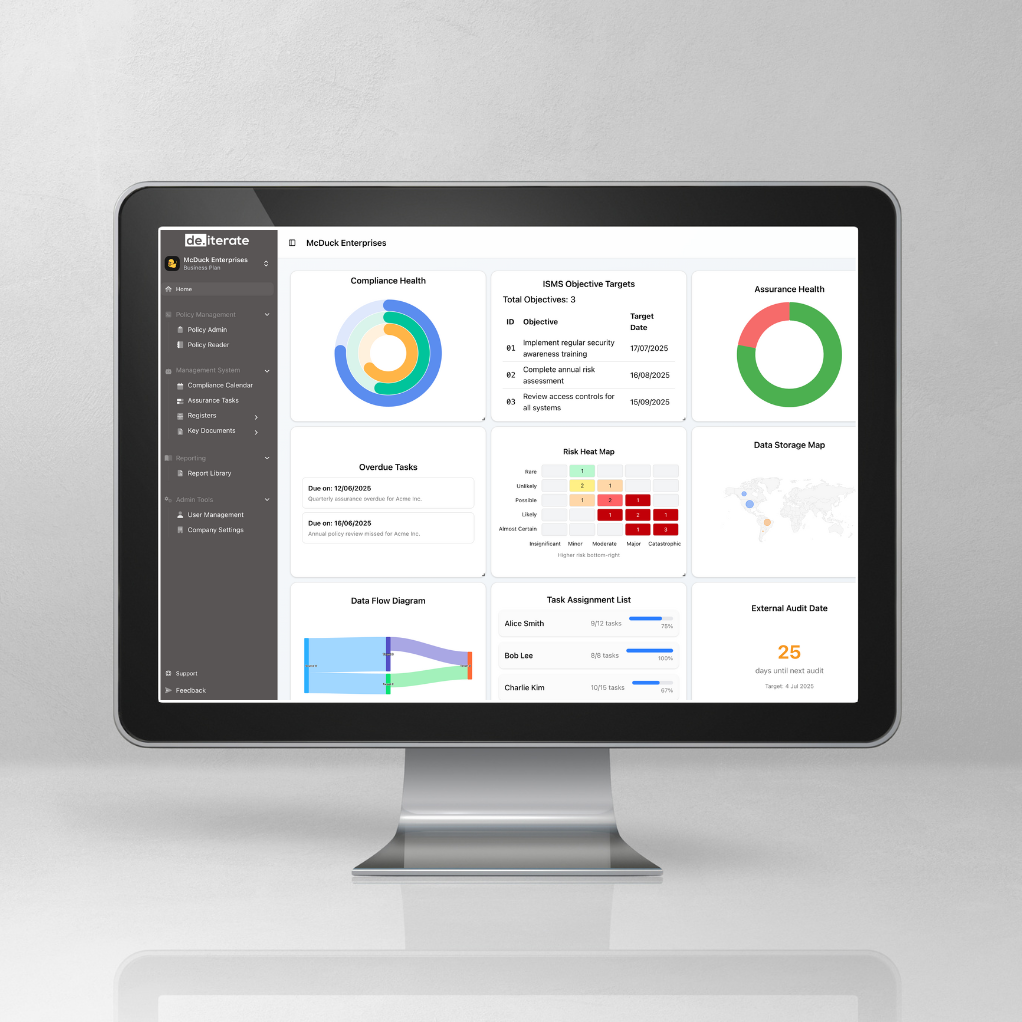
Scammers count on organisations being too busy over the holidays to do the basics. de.iterate makes the basics easier to keep doing. Keep your supplier register current, with owners, access and the data each supplier holds. Schedule access reviews and patching checks as recurring assurance tasks, so they don't slip during the Christmas shutdown. Record incidents and corrective actions in one place, and keep the evidence ready for your next audit.
So security hygiene becomes something you can see, manage and prove every day, not something you hope is happening.
Book a demo to see how it works, and from all of us at de.iterate, have a safe (and scam-free) festive season.
Tags: