

Compliance Can’t Live in One Person’s Head
For a lot of tech companies, SOC 2 becomes the first serious compliance milestone.
That makes sense. Enterprise customers ask for it. Procurement teams recognise it. Sales teams love having it in the security packet. And because a SOC 2 examination reports on controls relevant to security, availability, processing integrity, confidentiality or privacy, it is a widely used way for service organisations to demonstrate trust.
But here’s the problem: SOC 2 is not a complete trust strategy.
It is an important piece of the puzzle, but on its own it rarely gives growing tech companies everything they need to manage risk well, answer customer questions efficiently, support privacy obligations, and stay confidently audit-ready year-round.
That is why the strongest SaaS and technology businesses do not stop at SOC 2. They build what you could call a trust stack; a more complete operating model that combines SOC 2 with ISO 27001, privacy governance, and continuous assurance.
SOC 2 Is Valuable — But It Solves A Specific Problem
SOC 2 is designed to give report users assurance about controls at a service organisation that are relevant to one or more of the Trust Services Criteria. Every SOC 2 engagement includes Security, while Availability, Processing Integrity, Confidentiality and Privacy are selected based on what is relevant to the organisation’s services and commitments.
That is useful. It helps tech companies answer a big market question: Can we trust your systems and controls?
But enterprise buyers usually do not stop there.
They also want to know:
- how security is managed operationally
- how risk decisions are made
- how quickly evidence can be produced
- how privacy is governed
- how incidents, suppliers and changes are handled
- whether the company treats compliance as a living system or a once-a-year performance
A SOC 2 report can support that conversation, but it does not automatically mean the whole machine behind it is mature, connected or easy to maintain. That part still depends on how the business actually runs.
Why ISO 27001 Changes the Conversation
This is where ISO 27001 becomes strategically important.
ISO 27001 is the world’s best-known standard for information security management systems, and ISO describes it as a tool for risk management, cyber-resilience and operational excellence. It takes a holistic approach to information security. It covers people, policies and technology, and it requires the organisation to establish, implement, maintain and continually improve its information security management system.
That matters for tech companies because it shifts the conversation from Can we get through a SOC 2 audit?
To: Do we actually have a management system for security that works over time?
SOC 2 can be a powerful attestation. ISO 27001 helps build the underlying discipline. Together, they are stronger than either one alone.
Privacy Is Not Automatically Covered Just Because Security Is
This is another place where tech businesses get caught out.
A lot of SaaS companies treat privacy like a side note to security. But privacy obligations are not just about whether systems are secure. They are about whether personal data is collected, used, stored, shared and retained in ways that are lawful, transparent and accountable.
In Australia, the OAIC’s guidance is equally clear: organisations are expected to manage personal information in an open and transparent way, and to put in place the practices, procedures and systems needed to comply with the Australian Privacy Principles and deal with privacy inquiries and complaints. The APPs cover the full privacy lifecycle, including collection, use and disclosure, governance and accountability, security, and individuals’ rights to access and correct their personal information.
In other words, you can have strong security controls and still have a weak privacy program.
For a tech company handling customer data, employee data, analytics data or AI-related personal data, that gap becomes risky very quickly. It also becomes visible during procurement, legal review and customer due diligence.
The Trust Stack Tech Companies Actually Need
If you are selling into larger organisations, handling sensitive data or scaling quickly, the more useful model is not SOC 2 versus ISO 27001.
It is a stack that looks more like this:
1. SOC 2 for customer-facing assurance. SOC 2 helps answer the enterprise buyer’s question: do you have independently examined controls relevant to trust and security?
2. ISO 27001 for management-system discipline. ISO 27001 helps turn security into a defined, risk-based operating system rather than a loose collection of controls and policies.
3. Privacy governance for accountability. Privacy requirements demand more than technical controls. They require evidence of governance, records, decisions, transparency and accountability.
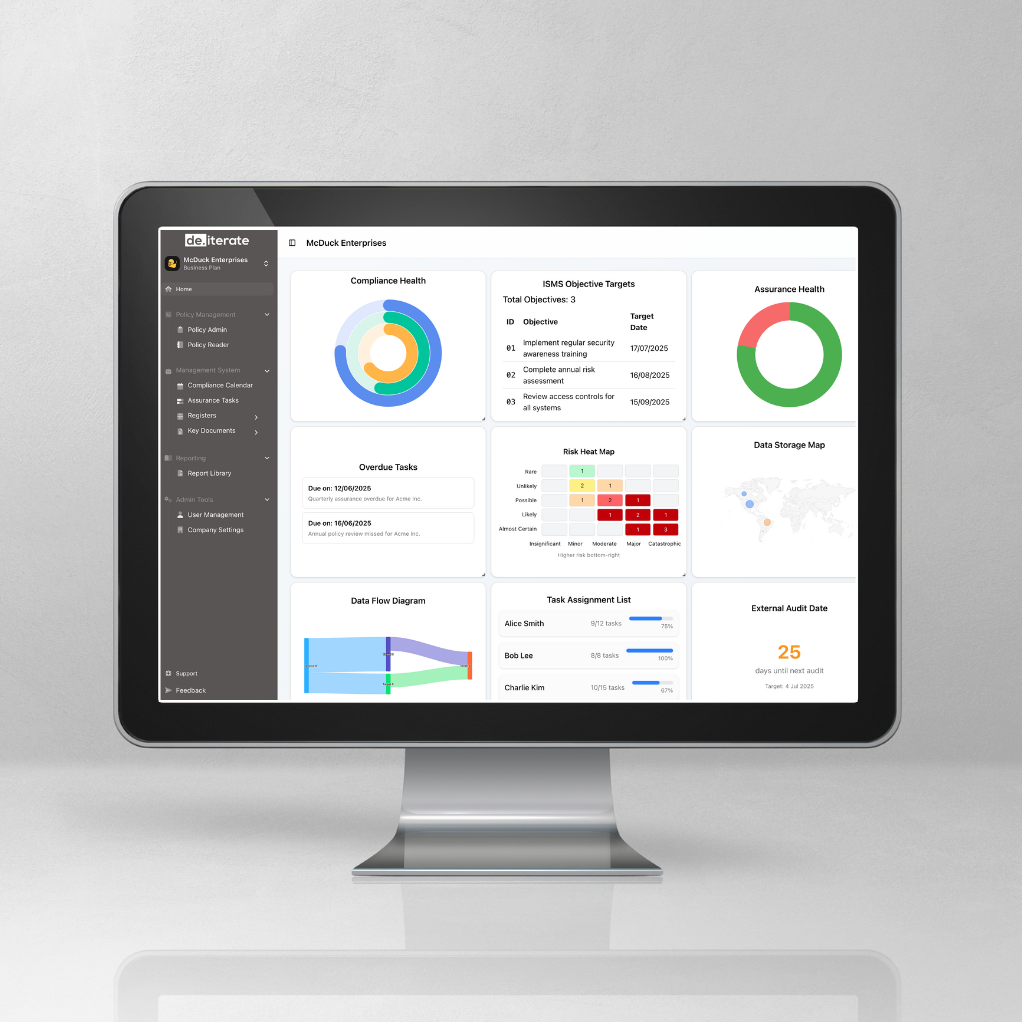
4. Continuous assurance for operational reality. This is the piece most organisations underestimate. Trust is not built only by achieving a report or certificate. It is built by being able to maintain policies, controls, evidence, reviews and accountability continuously (not just when the auditor or customer asks).
That is the real differentiator.
Why Continuous Assurance Matters So Much In SaaS
Tech businesses move fast. New features launch. Vendors change. Infrastructure evolves. Access patterns shift. Teams grow. Data flows multiply. AI tools get introduced quietly. Customer promises expand. The operating environment does not sit still. So a once-a-year compliance mindset quickly falls behind.
That is why continuous assurance matters more than ever. A strong trust stack means your business can:
- keep policies current
- link evidence to the right controls
- maintain live risk and asset visibility
- show privacy accountability
- answer customer questionnaires faster
- reduce scramble before audits
- give leadership a clearer view of where things stand
This is not just about passing. It is about operating like a company that is genuinely ready for scrutiny.
The Commercial Upside Is Real
When trust is operationalised properly, it does not just reduce risk. It improves growth.
It helps sales teams move faster through procurement. It reduces the stress and cost of audit preparation. It gives product, engineering and leadership a clearer framework for decision-making. And it helps customers feel more comfortable trusting your business with their data.
In a crowded tech market, that matters.
Because more and more, buyers are not just comparing features. They are comparing maturity.
SOC 2 is Not the Whole Story
SOC 2 is valuable. For many tech companies, it is essential. But it is not the whole story.
If you want a trust posture that holds up under customer scrutiny, scales with the business and supports long-term growth, you need more than a report. You need a trust stack built on customer-facing assurance, a real security management system, privacy accountability and continuous evidence-backed governance.
That is what moves a tech company from “compliant enough to answer the questionnaire” to “credible enough to win the deal.”
Tags: