

AI Threats Are Evolving And So Must Our Audits: Why Surface-Level Compliance Won’t Cut It Anymore
Let’s be real: no one wakes up excited to spend the day classifying data. For small businesses especially, data classification feels like one of those “we’ll get to it eventually” tasks—somewhere between reorganising the filing cabinet and switching electricity providers.
But if you’re planning to roll out AI (or already have), that “eventually” needs to become a right now.
Because if you don’t know what data you have, where it lives, and who can access it, then you’re playing a dangerous game with privacy, compliance, and customer trust.
“We Don’t Have That Much Data…” Are You Sure?
Here’s what usually happens.
You ask a small business where their employee data is. They’ll say something like: “It’s all in Xero and Employment Hero.”
Cool. Until you dig a little deeper. Then you find:
- Employment contracts and tax file numbers in someone’s email inbox
- A spreadsheet of emergency contact info in SharePoint
- Mental health disclosures or doctor’s certificates in a folder called “HR Stuff”
- CVs, superannuation forms, and salary details floating around in various places
Now we’re talking about personally identifiable information (PII) and sensitive health data spread across five systems, none of which were designed to keep it locked down by default.
Then someone flicks on Microsoft Copilot or plugs in a new AI app. And guess what? The AI doesn’t ask, “Should I really be looking in here?”
Nope. It just… does.
When AI Meets Access Creep
Access creep is like digital plaque. It builds up slowly until someone notices, usually too late. Take this common scenario:
Fred needed temporary access to the employee folder two years ago. No one removed it. Today, he types the following prompt into Copilot:
“How much do we know about employee Jane?”
And Copilot, doing its fancy AI automation search trick, pulls data from that old folder, because it can. It gives Fred a whole heap of personal information he didn’t need, from Jane’s salary through to confidential mental health records associated with a workers’ compensation claim. The AI doesn’t care about intent. It sees access as a green light.
Or another example: Jane used to work in finance. Now she’s in sales. But she still has access to legal and M&A files from 2019 because “she used to need it”.
Fast forward—Jane asks Copilot: “Show me our sales trends over five years.”
AI delivers… plus some bonus confidential merger details no one meant to include.
This Isn’t a Hypothetical Risk
AI is only as safe as your access controls. If your permissions are loose, your data is too. But here’s the catch: you can’t fix what you can’t see. And that’s where data classification comes in.
It’s not just an exercise in neatness. It’s how you figure out:
- What kinds of data you actually have (e.g. personal, financial, sensitive, confidential)
- Where that data lives (systems, folders, inboxes, Slack threads… you name it)
- Who has access, and who shouldn’t
Only then can you apply guardrails, like:
- Role-based access control (RBAC)
- Just-in-time access (JIT)
- MFA prompts for sensitive files
- Data loss prevention (DLP) policies
Yes, It’s Hard. But It’s Harder Without a Process.
We get it. Data governance isn’t free. It takes time, people, and money. But AI doesn’t wait around for your policies to catch up. And compliance regulators? They’re not impressed by “we didn’t have time”.
Doing this manually in spreadsheets will drive you mad. It’s messy, time-consuming, and easy to miss things.
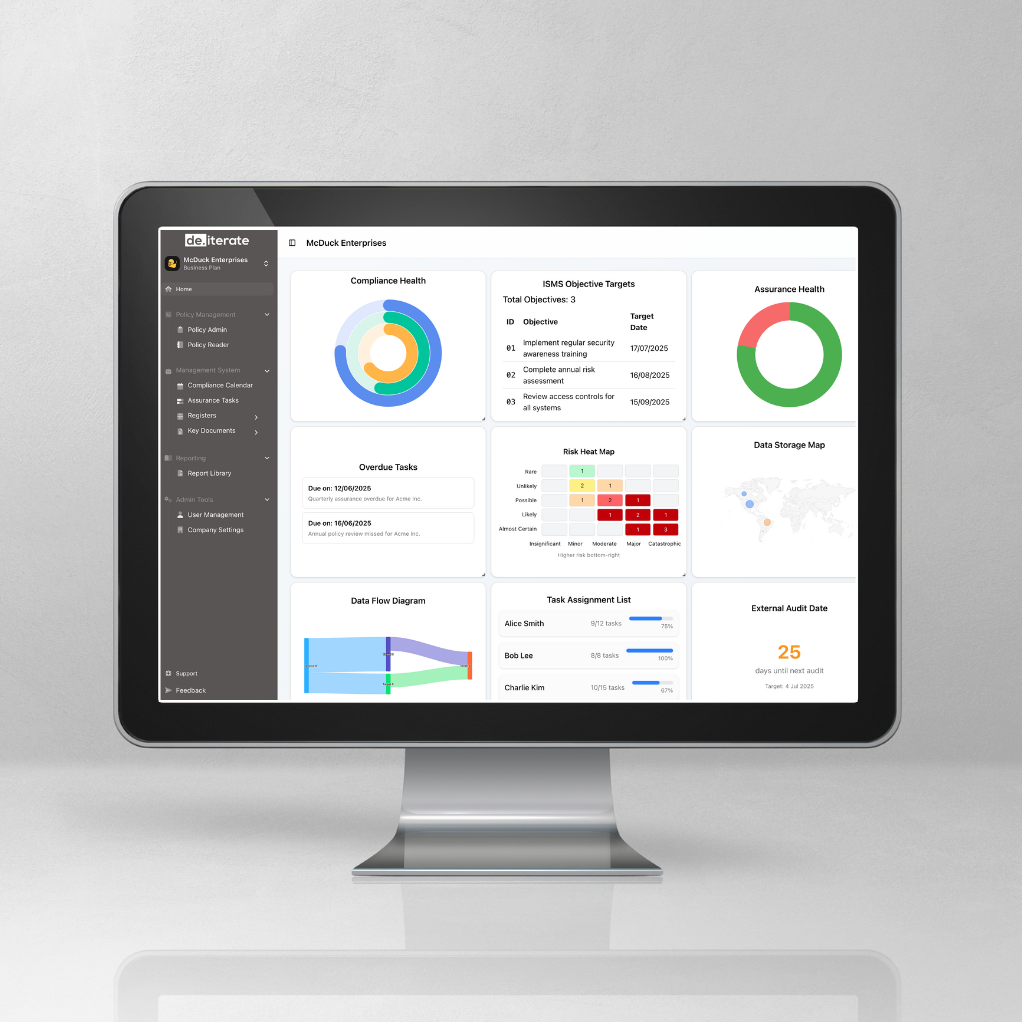
That’s why de.iterate exists.
We give you tools that:
- Map your data across systems
- Classify it by sensitivity
- Spot AI exposure before it happens
- Help you meet ISO 27001 and privacy obligations without drowning in admin
AI is exciting. But if you’re feeding it unclassified, over-exposed, poorly governed data, you’re not just inviting innovation. You’re inviting risk.
Data classification isn’t busywork. It’s the foundation of safe AI use, good governance, and long-term trust.
Know what you’ve got. Protect what matters. Let AI do the rest.
Tags: