


APRA Warns: AI Governance Needs to Be Operational, Not Aspirational
In the race to “get compliant”, a lot of businesses are turning to technology, particularly for the collection of evidence of compliance. And fair enough too. Nobody wants to spend their days chasing screenshots, digging through logs, or manually filling out audit checklists.
There’s a huge upside to using automation to streamline compliance. Done right, it saves time, reduces errors, and helps you demonstrate that you’re doing what you say you’re doing.
But here’s the catch: automating compliance without context is like following a map without knowing where you’re going. You might be moving fast, but you have no idea if you’re headed in the right direction.
And when it comes to standards like ISO 27001, that’s not just inefficient — it’s dangerous.
What Technology Can Do
Technology is brilliant at repeatable, verifiable tasks. All the stuff humans hate, computers usually love.
Think:
- Capturing logs and system screenshots
- Monitoring backup activity
- Flagging configuration changes
- Showing last login dates, patch times, and antivirus status
All of these things are valuable. You should automate them where it makes sense. But these activities are only meaningful if they’re connected to a bigger picture — namely, your organisation’s documented processes, procedures, assets and risks.
Because compliance is not about ticking boxes. It’s about proving that the controls you’ve said are in place… actually are, and are applied where they’re supposed to be.
Context Is Everything
Let’s say your backup tool takes daily screenshots showing your main file server is backed up. Tick. Evidence collected. Compliance maintained, right?
Not so fast.
What if you’ve added another server recently, and it’s not covered by the same backup process?
What if a legacy system in a regional office stores sensitive data but isn’t even listed in your asset register?
What if your risk register identifies certain systems as critical to operations, and those aren’t the ones being backed up?
This is where context comes in.
Automation can prove that something happened. But it can’t tell you if everything that should have happened, did.
Unless you’ve got a process that connects your asset list, risk register, and backup procedure, those beautiful screenshots are just noise. Without context, you’re automating a false sense of security.
The ISO 27001 Lens
ISO 27001 doesn’t just ask you to back things up. It asks you to:
- Identify your critical information assets
- Assess the risks associated with those assets
- Document the controls that mitigate those risks
- Prove that those controls are working effectively
Nowhere does it say: “Take a random screenshot and call it a day.”
Evidence collection is just the end of the chain. If the rest of the chain — asset identification, risk assessment, process definition — isn’t there, then the evidence is meaningless.
Automating evidence collection after defining your context? Smart.
Automating evidence collection instead of defining your context? Risky.
What Good Looks Like
A well-designed compliance approach does four things:
- Documents intent: Your policies and procedures clearly state what should happen and why.
- Establishes scope: Your asset register and risk register define what’s in play and what matters most.
- Collects evidence with purpose: Your automated systems are fed the context above — so when you capture evidence, it applies to all the context you intended.
- Human in the loop: Evidence is reviewed and assessed for relevance, accuracy and effectiveness.
That’s real compliance. Not just ticking a box, or connecting an API, but building a Management System that understands the “why” behind the “what.”
How de.iterate Can Help
At de.iterate, we believe automation should amplify and augment your governance — not replace it.
Our platform:
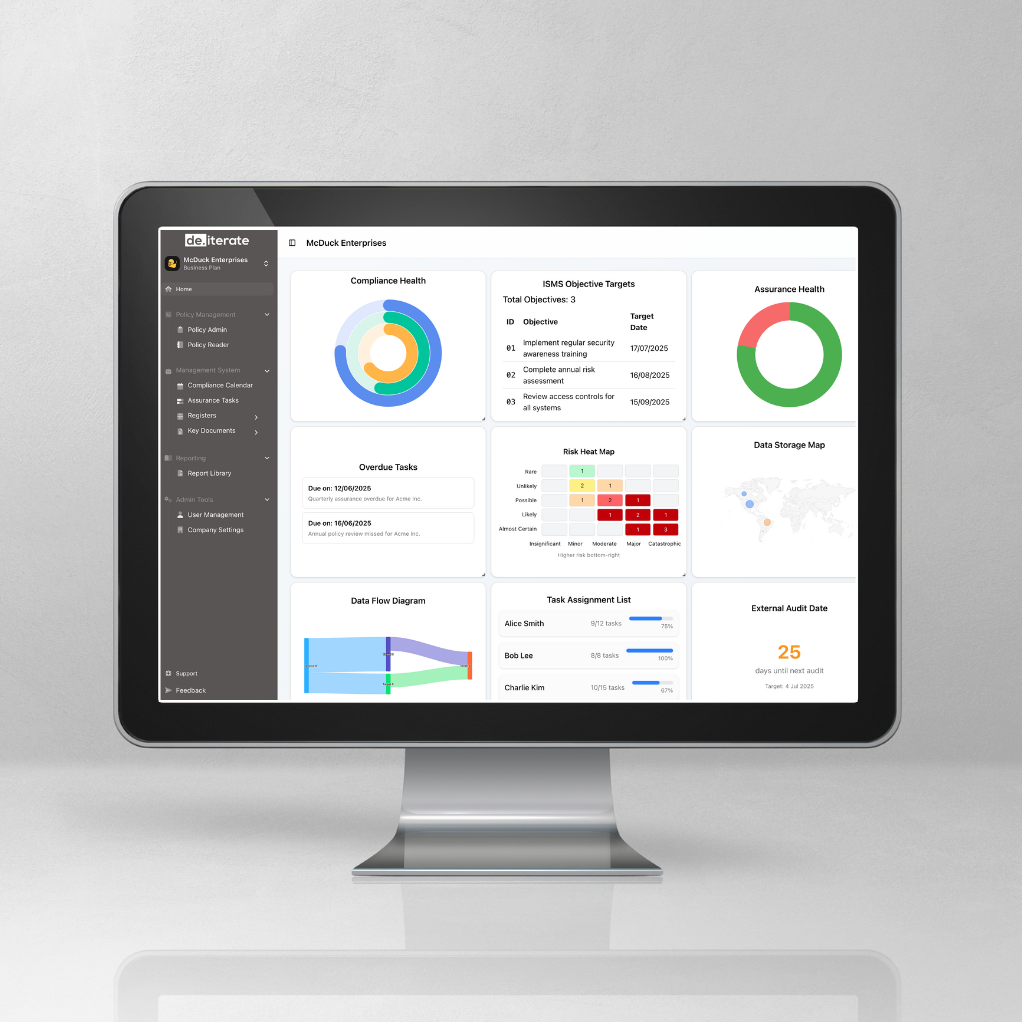
- Connects your risk register, asset list, and control library in one place
- Helps you define meaningful procedures that drive the right evidence collection
- Makes it easy to track what matters, and flag what’s missing
- Integrates with your tools to automate evidence, in context
- Enables the human in the loop to assess effectiveness
- Provide assurance that governance controls are implemented and operating as intended
Because compliance without context is just activity. And activity isn’t the same as assurance.
Don’t Automate for the Sake of It
Technology is a powerful ally. But if you’re not careful, it can also be a distraction — especially when it gives you the illusion that everything’s fine because the boxes are ticked.
Don’t automate for the sake of it. Automate with intent. Use context to guide your evidence collection, and your compliance program will actually mean something.
Otherwise, you’re just automating failure — faster.
Tags:

.png?width=500&height=500&name=pen-test-risk-management%20(1).png)