


APRA Warns: AI Governance Needs to Be Operational, Not Aspirational
Every risk register has a column for “owner.”
Which is great.
Very grown up.
Very governance-y.
The problem is that in many organisations, the risk owner is not really an owner.
They are more like a name in a box.
A person who may or may not know they have been assigned the risk. A person who may not have authority to do anything about it. A person who has definitely never been asked whether the treatment plan is working.
This is how risk management becomes theatre-adjacent. Not full theatre. More like a dress rehearsal with a spreadsheet.
Ownership Means Something
A real risk owner is not just the person closest to the problem. They are the person accountable for making sure the risk is understood, monitored and treated appropriately.
That does not mean they personally fix everything. It means they know what is happening, can make or influence decisions, and can explain the current status without needing to “circle back after checking with the team.”
If your risk owner cannot answer basic questions about the risk, they probably do not own it. They are just visiting.
The “IT Owns Cyber Risk” Problem
This happens constantly. A cyber risk appears. Everyone looks at IT. And yes, IT often owns technical controls. But that does not mean IT owns every cyber-related risk.
If a risk affects customer trust, legal obligations, operational continuity, revenue, board reporting or strategic delivery, then it is broader than technology.
Cyber risk is business risk wearing a hoodie. Sometimes a very expensive hoodie.
That means ownership needs to sit where accountability actually belongs.
A supplier risk may belong with procurement or operations. A privacy risk may need legal, compliance and business input. A continuity risk may sit with an executive owner, supported by IT. A product security risk may involve engineering, product and leadership.
If everything is dumped into IT’s lap, the risk register may look complete, but the accountability model is broken.
Risk Treatment without Authority is Just Optimism
Another common issue is assigning risks to people who cannot actually make decisions.
They can see the problem. They may even understand the treatment plan. But they do not control budget, priorities, resources or process changes. So the risk sits there. Reviewed quarterly. Updated politely. Still unresolved.
This is not risk management. This is risk journaling.
A good risk owner needs enough authority, influence or escalation pathway to move the risk forward. Otherwise, the register becomes a graveyard of well-described concerns.
The Review Cycle Matters
Risk ownership is not a one-time assignment. Businesses change. Systems change. Suppliers change. People leave. Controls drift. Threats evolve. What looked acceptable six months ago may now be very much not acceptable. That is why risk reviews matter.
Not the kind where someone opens the register five minutes before the governance meeting and changes “medium” to “medium-ish.” Actual reviews.
The risk owner should be able to confirm whether:
- the risk is still relevant
- the rating still makes sense
- treatments are progressing
- controls are working
- anything has changed
- escalation is needed
That is where the register becomes useful.
Good Ownership Makes Reporting Better
Leadership does not need a risk register full of vague descriptions and stale ratings. They need insight.
Where are the biggest risks?
Which treatments are overdue?
Which risks are accepted and why?
Where does the business need to make a decision?
Strong risk ownership makes those answers clearer. Weak ownership creates noise. And no board has ever said, “Please give us more noise in table format.” At least, not out loud.
Real Ownership = Real Risk Management
A risk register is only as good as the ownership behind it. If the owner field is just admin, the register will not drive action. It will record concern, create false comfort and slowly become one more compliance artefact nobody trusts. But when ownership is real, risk management starts to work.
Risks are understood. Decisions are clearer. Treatments move. Reporting improves. Accountability becomes visible. And the risk register stops being a spreadsheet with ambitions. It becomes a management tool.
Imagine that.
Need Help Getting Your Ducks in a Row?
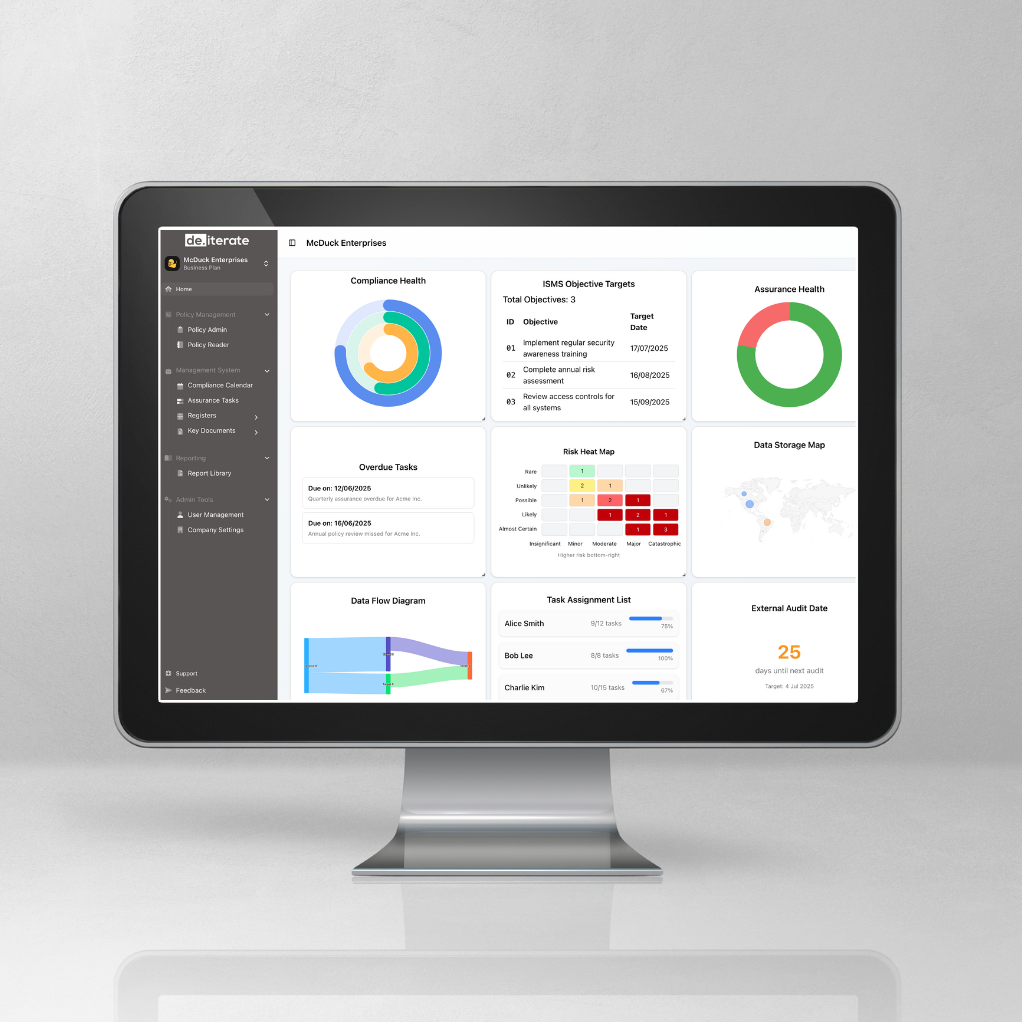
de.iterate helps organisations manage risks, owners, treatment plans, evidence and assurance activity in one connected platform. So risk ownership is not just a field in a register.
It is part of how the business actually runs.
Tags:

.png?width=500&height=500&name=pen-test-risk-management%20(1).png)