


APRA Warns: AI Governance Needs to Be Operational, Not Aspirational
We’ve all seen it: the posters in the IT department, the scary stats in quarterly risk reports, the occasional phishing simulation that catches the office prankster off guard.
Cybersecurity is everywhere. Or, at least, it should be. But somehow, despite all the awareness campaigns and mandatory training modules, it still feels like something that belongs in the realm of tech specialists, not the average employee.
And that’s a problem. Because here’s the thing: cybersecurity isn’t a tech problem. It’s a business problem.
The Real Threat? Apathy.
We don’t have a skills shortage. We have an interest shortage.
Yes, there’s a need for more cybersecurity professionals. But what’s hurting businesses most isn’t a lack of talent. It’s a lack of engagement across non-tech roles.
Finance, HR, marketing, operations…these are the departments that handle sensitive data every day. And yet, security is still seen as something ‘the IT team deals with.’
Until that changes, we’ll keep seeing the same breaches, the same near misses, and the same reactive finger-pointing when things go wrong.
Embed It or Forget It
Security best practices shouldn’t be bolted on. They should be built in.
We need to stop treating cybersecurity like a separate skill set and start embedding it into every job description:
- HR staff should understand privacy risks in recruitment and employee data handling.
- Finance teams should be trained to spot invoice scams and protect payment systems.
- Marketers should be fluent in consent, cookies, and compliance.
- Everyone should know the basics of phishing, password hygiene, and data sharing.
Cybersecurity should be as much a part of business culture as OH&S. We don’t let people walk around a job site without PPE. So why are we letting them share passwords, ignore software updates, or send sensitive files unencrypted?
Link It to KPIs. Yes, Really.
You want people to take security seriously? Make it part of performance reviews.
We’re not talking about unfairly penalising people for clicking one dodgy link. We’re talking about accountability:
- Have you completed your cyber security training?
- Have you noticed and NOT reported any suspicious activity since our last review?
- Are you following our data handling processes?
- Has your team performed any supplier security reviews since our last review?
Cybersecurity isn’t about being perfect. It’s about being responsible. And responsibility grows when it’s measured, recognised, and rewarded.
The ISO 27001 Way: Built on Shared Responsibility
One of the reasons we love ISO 27001 (yes, we’re nerds and proud) is because it bakes this shared responsibility into its core. The standard isn’t just for the IT team or the CISO. It’s for everyone. It’s about building a culture of information security, where continuous improvement and collaboration are key.
And the good news? You don’t need to do it alone.
How de.iterate Helps
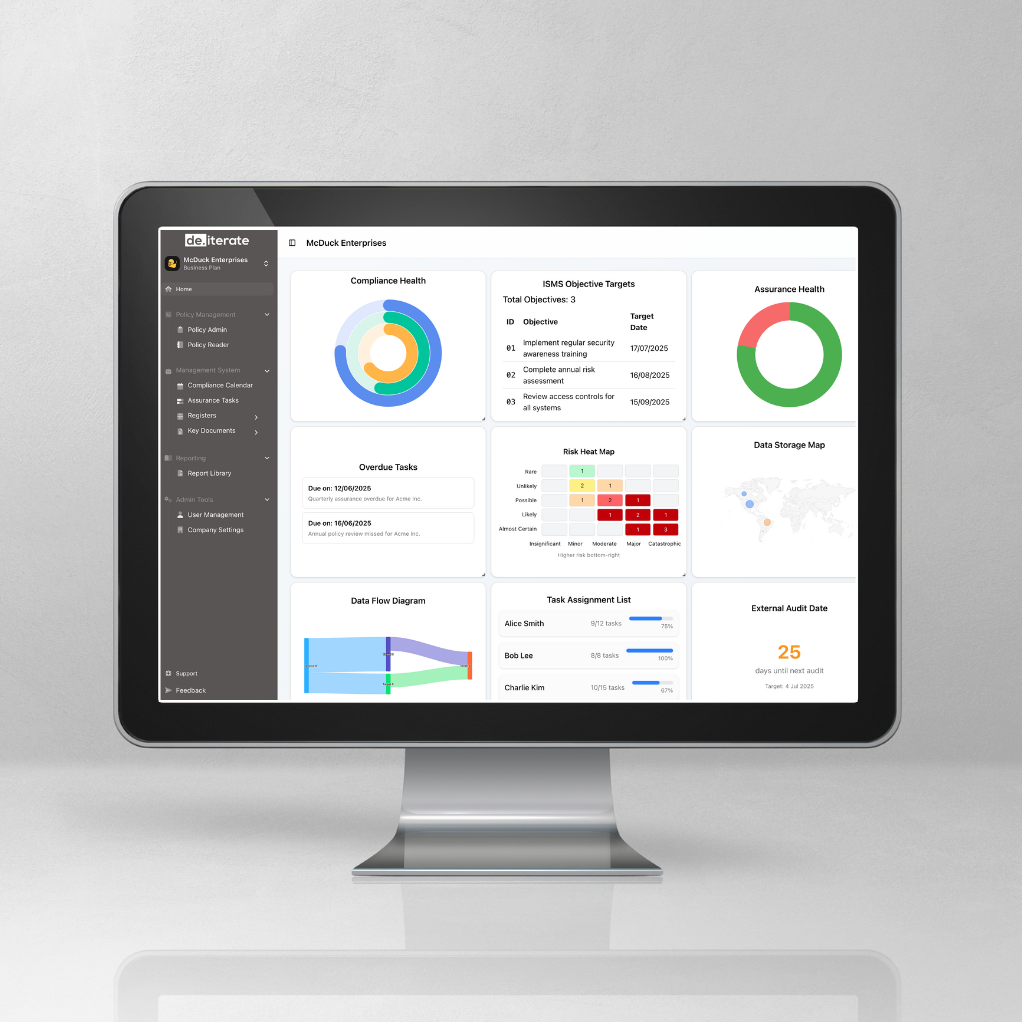
At de.iterate, we help organisations operationalise cybersecurity and privacy across the business, not just in the server room.
With automated workflows, real-time visibility, and version-controlled documentation, it’s easier than ever to:
- Assign responsibilities across departments
- Track compliance activity (not just policies, but actual practice)
- Roll out minimum viable controls and improve over time
- Get ISO 27001-ready without waiting for perfection
In other words, we make it simple for every team—HR, Finance, Ops, Sales, even the CEO—to know what their role is, take ownership, and show progress.
Final Thoughts: Security is a Team Sport
The myth of the lone IT hero saving the day is just that. A myth. Real cybersecurity resilience comes when everyone plays their part. It’s time to move beyond awareness and into action. Not just for auditors, not just for checklists, and definitely not just for the tech team.
So go on. Add “cyber safe” to that job description. Make it a KPI. Talk about it in team meetings. Treat it like the business-critical issue it is.
Because in today’s world, if it touches data, it touches risk. And that means it touches all of us.
Tags:

.png?width=500&height=500&name=pen-test-risk-management%20(1).png)