


Don’t Be a Digital Hoarder: The Real Risk of Keeping Too Much Data
There’s a moment every year when it happens. Someone says, “The auditor will be here in four weeks.” And suddenly:
- Slack channels light up
- Screenshots are being requested at alarming rates
- Policies are being “lightly refreshed”
- Someone is digging through last year’s folder structure like it’s an archaeological site.
If that sounds familiar, you’re not alone. Most organisations don’t have a compliance problem. They have an evidence problem. Because being compliant and being able to prove you’re compliant are two very different things.
First: What Does “Audit-Ready Evidence” Actually Mean?
Whether you’re dealing with ISO 27001, SOC 2, GDPR, or any other framework, auditors aren’t looking for vibes. They’re looking for verifiable proof that:
- Controls exist
- Controls are documented
- Controls are implemented
- Controls are operating effectively
- Controls are reviewed and improved
Audit-ready evidence is clear, traceable and repeatable.
For ISO 27001, that might include:
- Risk assessments and treatment plans
- Management review minutes
- Internal audit results
- Access reviews
- Incident records
- Control monitoring logs
For SOC 2, it often means:
- Screenshots demonstrating configurations
- Exported system logs
- Evidence of ticket approvals
- Records showing controls operated over time
For GDPR or privacy compliance:
- Data processing records
- Consent logs
- DPIAs
- Breach registers
The common thread? Evidence must show that the control isn’t theoretical. It’s real, operating, and embedded.
Good Evidence vs Bad Evidence (Yes, There’s a Difference)
Let’s be honest. Not all evidence is created equal.
Bad evidence tends to look like:
- A policy written last week with no revision history
- A spreadsheet showing access reviews with no sign-off
- A screenshot without a date stamp
- A document titled “Risk Register_Final_v7_REAL_FINAL”
- Verbal confirmation that “we usually do that”
Bad evidence tells a story of panic.
Good evidence, on the other hand:
- Is timestamped
- Shows ownership
- Demonstrates review or approval
- Links clearly to a control requirement
- Reflects normal operational activity
Good evidence tells a story of maturity. The auditor should be able to trace the control lifecycle: planned, implemented, monitored, reviewed. If you have to explain it too much, it’s probably not strong evidence.
The Real Problem: Evidence Collected in Bursts
Most organisations collect evidence reactively. They do the work throughout the year but they don’t capture proof of that work as it happens. Then audit season arrives and everyone tries to reconstruct history. That’s when:
- Screenshots are recreated
- Logs are pulled retroactively
- Review records are written up after the fact
- People rely on memory
And memory is not an ISO control. The shift from annual scramble to continuous confidence happens when you move from “evidence later” to “evidence first”.
Manual vs Automated Evidence Collection
Let’s talk about the elephant in the server room.
Manual evidence collection is slow, inconsistent and heavily dependent on individuals remembering to do things. It works when:
- Your organisation is small
- Your systems are simple
- Your compliance scope is narrow
But as soon as you scale, manual collection starts to break down.
Automated evidence collection, on the other hand, allows you to:
- Pull system configurations automatically
- Capture change logs in real time
- Sync access control data
- Track ticket approvals
- Monitor control effectiveness continuously
Automation doesn’t replace governance. It strengthens it. It reduces human error. It improves consistency. It creates an audit trail without the chaos. But automation only works if it’s structured properly within your compliance framework.
What an “Evidence-First” Approach Looks Like
An evidence-first organisation doesn’t wait for audits to think about documentation. Instead, it builds evidence capture into daily operations. Risk assessments are logged in real time. Access reviews are documented when completed; not when remembered. Incident response activities are recorded during the incident; not summarised months later. Policy updates trigger version control automatically.
Evidence becomes a byproduct of doing things properly, not a separate administrative exercise.
And when the auditor arrives? Nothing changes. That’s the goal.
How to Operationalise Evidence (Without Becoming Bureaucratic)
You don’t need more paperwork. You need smarter workflows. Start by:
- Defining clear ownership for each control
- Linking controls to specific evidence types
- Establishing review cycles with automated reminders
- Using centralised storage (not five different tools)
- Avoiding duplicate documentation
The key is alignment. When each control has a defined evidence stream, and each evidence stream has an owner, the entire system becomes predictable.
Where de.iterate Fits In
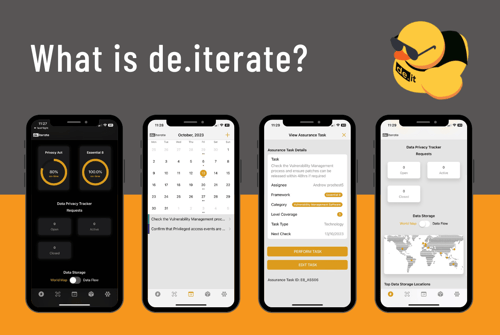
At de.iterate, we built the platform around a simple idea: Compliance should be continuous and evidence should be automatic wherever possible. Our platform helps you:
- Map controls to multiple frameworks (ISO 27001, SOC 2, GDPR and more)
- Assign clear ownership
- Capture and store evidence centrally
- Automate reminders and review cycles
- Integrate with existing systems for real-time data capture
- Monitor control effectiveness, not just control existence
- Maintain a live, always-ready evidence library
Instead of scrambling once a year, you operate with continuous assurance. Instead of duplicating evidence across frameworks, you map once and reuse intelligently. Instead of asking, “Where’s that screenshot?”, you already know.
Final Thought: Calm Is a Compliance Strategy
Audit chaos isn’t inevitable. It’s usually a symptom of fragmented evidence management.
If your goal is to reduce stress, strengthen governance, and scale efficiently, the answer isn’t working harder in the final month. It’s embedding evidence collection into the rhythm of your organisation.
Evidence first. Panic never.
And when the auditor emails to confirm their arrival date? You’ll already be ready.