


Human Factors in Security: How People, Culture & Behaviour Impact Your ISMS
Businesses are increasingly looking for ways to streamline their operations, enhance efficiency, and meet multiple regulatory requirements without doubling their workload.
Integrating ISO 27001 (Information Security Management) with other management systems like ISO 9001 (Quality Management), ISO 14001 (Environmental Management), and ISO 45001 (Occupational Health and Safety Management) offers a powerful solution — and with de.iterate, integration has never been easier.
In this blog, we’ll explore why integration makes sense, the benefits it delivers, and how de.iterate simplifies the process for your organisation.
Why Integrate Management Systems?
Managing each ISO standard separately leads to duplication of effort, wasted resources, and operational inefficiencies. Often, businesses find themselves:
- Performing multiple audits that review overlapping processes
- Duplicating documentation across separate systems
- Creating confusion among employees trying to meet different sets of requirements
Integration solves these problems by creating a unified management system that addresses all compliance obligations in a single, streamlined framework. This means shared policies, coordinated objectives, integrated audits, and aligned risk management processes.
When done properly, integration not only makes day-to-day compliance easier but also turns governance into a strategic advantage.
The Benefits of Integrating ISO 27001 with ISO 9001, ISO 14001, and ISO 45001
1. Increased Efficiency and Reduced Duplication
Many clauses across ISO 27001, ISO 9001, ISO 14001, and ISO 45001 overlap, particularly those relating to context analysis, leadership commitment, internal audits, continual improvement, and document control. By integrating systems, organisations can address these common elements once rather than multiple times.
2. Enhanced Risk Management
Each standard takes a risk-based approach to managing different areas: information security (ISO 27001), quality (ISO 9001), environmental impact (ISO 14001), and worker safety (ISO 45001). Integration enables a holistic view of organisational risk, helping businesses to identify interdependencies and better prioritise actions.
3. Streamlined Audits and Certification
Integrated audits allow certification bodies to assess multiple standards simultaneously, helping to save time, reduce disruption, and cut external audit costs.
4. Improved Decision-Making
A single, unified system helps deliver consolidated data and reporting, enabling better strategic decision-making. Leadership teams gain clearer insights into business performance across compliance, quality, security, safety, and sustainability.
5. Stronger Organisational Culture
Integration helps foster a culture of continuous improvement, shared ownership, and compliance awareness throughout the organisation. It eliminates silos and encourages employees to think beyond departmental boundaries.
How to Integrate ISO 27001 with Other Management Systems (the Smart Way)
While the benefits are clear, integration must be approached methodically to succeed. Here’s how de.iterate makes it simple.
1.Start with a Unified Framework
de.iterate provides a single platform that houses all your management system requirements. It is pre-configured to align with the structures of ISO 27001, ISO 9001, ISO 14001, and ISO 45001, allowing you to build an Integrated Management System (IMS) from day one.
2.Map Common Clauses and Controls
Using de.iterate’s smart mapping features, you can easily identify and link common requirements across standards. For example, leadership engagement, document control, and continual improvement processes can be managed under a single, integrated framework.
3. Centralise Documentation and Evidence Collection
de.iterate consolidates all documentation in one secure platform, ensuring policies, procedures, risk registers, audit findings, and management reviews meet the needs of all applicable standards without duplication.
4. Align Objectives and Risk Assessments
With de.iterate, organisations can define integrated objectives that satisfy multiple standards (such as improving security, quality, and safety outcomes simultaneously). Risk assessments can also be tailored to consider overlapping impacts across different domains.
5. Streamline Internal Audits and Management Reviews
The platform enables you to schedule combined internal audits and management reviews, focusing on the full integrated system rather than treating each standard separately.
6. Automate Ongoing Compliance Monitoring
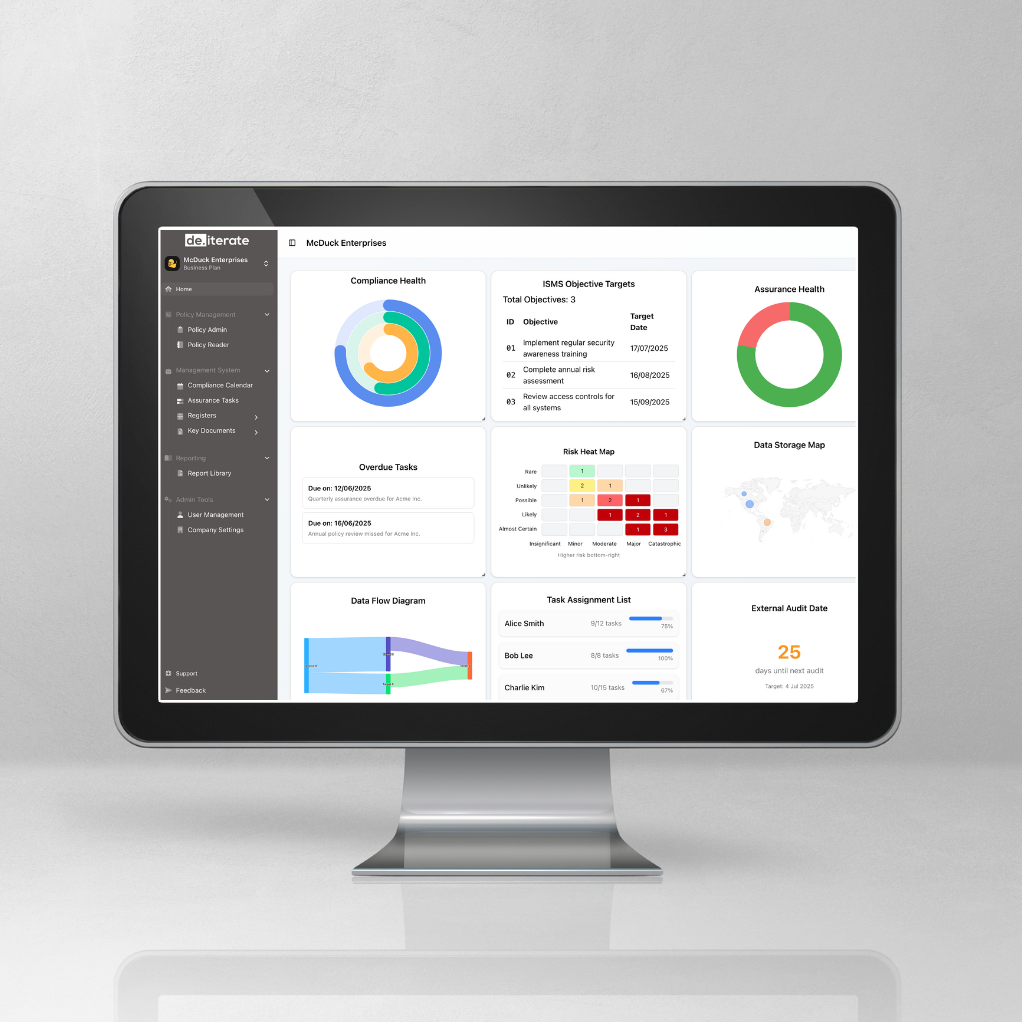
Automated reminders, assurance tasks, compliance calendars, and dashboards keep you on track across all standards, ensuring that integration is not a one-off project but an ongoing operational advantage.
Why de.iterate is the Best Choice for Management System Integration
de.iterate was built from the ground up to simplify compliance management, particularly for businesses managing multiple standards. With de.iterate, you can:
- Reduce the administrative burden of compliance by up to 75%
- Cut audit preparation time dramatically
- Ensure consistency and accuracy across all standards
- Strengthen risk management and governance
- Position your organisation for long-term growth and resilience
Integration doesn’t just save time and money — it makes your business stronger, smarter, and better prepared for the future.
Ready to streamline your compliance processes and unlock the power of integration?
Discover how de.iterate can help you build a smarter, unified management system today. Schedule a demo now.
Tags: