

Compliance Can’t Live in One Person’s Head
Everyone wants AI.
Boards want it. Marketing teams are already using it. Developers are building with it. Your competitors are talking about it loudly on LinkedIn.
But here’s the slightly uncomfortable question: Is your ISMS ready for it?
Because while AI is evolving at lightning speed, compliance frameworks (including ISO 27001) aren’t magically updating themselves to keep up with your shiny new chatbot, recommendation engine or AI-driven analytics platform.
The good news? ISO 27001 absolutely can support responsible AI use.
The catch? You have to apply it intentionally.
Let’s break down how to align AI governance with ISO 27001 in a way that’s practical, proportionate and (most importantly) not bureaucratic.
First Things First: ISO 27001 Doesn’t Mention AI (But It’s Still Watching)
ISO 27001 isn’t an “AI standard”. It doesn’t tell you how to train models or validate algorithms.
(Side note: ISO 42001 Artificial Intelligence Management Systems is the international standard that specifies the requirements for managing AI systems responsibly and ethically. It’s all about ensuring the transparent and trustworthy development and use of AI technologies. de.iterate can help with certification to this too – if you’re keen!)
What ISO 27001 does require is something much more powerful:
- Structured risk assessment
- Change management
- Asset management
- Access control
- Monitoring and review
- Continuous improvement
In other words: governance.
And AI, for all its futuristic flair, is just another information processing activity. A complex one, yes, but still subject to the same principles of risk, control and accountability. If your AI adoption sits outside your ISMS, you don’t have innovation. You have unmanaged risk.
Step 1: Treat AI as a High-Risk Change (Because It Is)
ISO 27001 Clause 6 (planning) and Clause 8 (operation) expect organisations to identify and assess risks associated with new systems and changes. Introducing AI isn’t just “adding a feature”. It can introduce:
- Data leakage risks
- Model bias and discrimination
- Hallucinated outputs
- Regulatory exposure
- Third-party dependency risk
- Intellectual property concerns
- Increased attack surface
Under ISO 27001, that means:
- Conducting a formal risk assessment
- Identifying affected assets (data, models, APIs, infrastructure)
- Evaluating impact and likelihood
- Defining treatment actions
- Documenting decisions
If your team launched an AI tool because “everyone’s doing it” without a risk assessment, congratulations! You’ve just created compliance debt.
Step 2: Expand Your Asset Register (Yes, Even the Algorithms)
ISO 27001 requires you to identify and manage information assets. Traditionally, that meant databases, applications, servers. Now it includes:
- AI models
- Training datasets
- Prompts and prompt libraries
- Model outputs
- Third-party AI platforms
- API integrations
- Model monitoring logs
If it processes, generates, or influences decisions about information, it’s an asset. All assets require:
- Ownership
- Classification
- Protection measures
- Lifecycle management
If no one owns the AI model, then everyone owns the incident.
Step 3: Embed Ethical AI Into Your ISMS (Not Just Your Marketing Page)
Responsible AI isn’t just a PR line. It’s a governance requirement. ISO 27001 doesn’t explicitly say “avoid algorithmic bias”, but it does require:
- Protection of confidentiality, integrity and availability
- Legal and regulatory compliance
- Risk-based decision making
- Continuous improvement
To embed ethical AI practices into your ISMS, consider:
- Data Integrity Controls: Ensure training data is accurate, relevant, and lawfully obtained.
- Access Control: Who can modify models? Who can retrain them? Who can deploy them?
- Bias and Fairness Reviews: Document testing processes to detect discriminatory outcomes.
- Transparency and Documentation: Maintain records of:
- Model purpose
- Data sources
- Testing methods
- Limitations
- Known risks
Step 4: Monitor AI-Driven Risks (Continuously, Not Casually)
Clause 9 of ISO 27001 focuses on performance evaluation. That includes monitoring control effectiveness. For AI systems, that could mean:
- Tracking model drift
- Reviewing unusual output behaviour
- Logging prompt activity
- Monitoring data access patterns
- Reviewing API call volumes
- Auditing model retraining events
AI doesn’t sit still. Your monitoring shouldn’t either. If your organisation deployed AI six months ago and hasn’t reviewed it since, you’re not governing it. You’re hoping for the best.
Step 5: Address Supplier and Third-Party AI Risk
Most organisations aren’t building large language models from scratch. They’re using third-party platforms. ISO 27001 Control 5.19 and 5.20 (supplier relationships) expect you to manage that risk. Questions to ask:
- Where is the data processed?
- Is it used for model training?
- What security controls are in place?
- What are the data retention policies?
- How are incidents handled?
- What certifications does the provider hold?
“Trust us” isn’t a control.
Step 6: Update Your Policies (Without Writing a Novel)
You don’t need a 75-page AI manifesto. But you should update your:
- Acceptable Use Policy (Can staff paste customer data into ChatGPT?)
- Data Classification Policy
- Change Management Procedure
- Risk Assessment Methodology
- Supplier Security Policy
Policies should reflect reality. If your teams are using AI but your documentation says nothing about it, that gap will eventually surface (probably during an audit).
Practical AI Governance Controls to Consider
Here are a few concrete, ISO-aligned processes you can implement:
- AI risk assessment template
- Model approval workflow before deployment
- AI use register (what tools are approved)
- Prompt and output logging controls
- Periodic AI review meetings
- Defined AI incident response process
- AI training and awareness sessions for staff
- Clear ownership and accountability structure
None of these are revolutionary. They’re structured, proportionate governance practices. And that’s the point.
Why This Matters Now
AI regulation is accelerating globally. Customers are asking harder questions. Auditors are becoming more AI-aware. And the organisations that treat AI governance as an afterthought will eventually find themselves scrambling.
ISO 27001 gives you the framework. You just need to extend it intelligently.
How de.iterate Helps
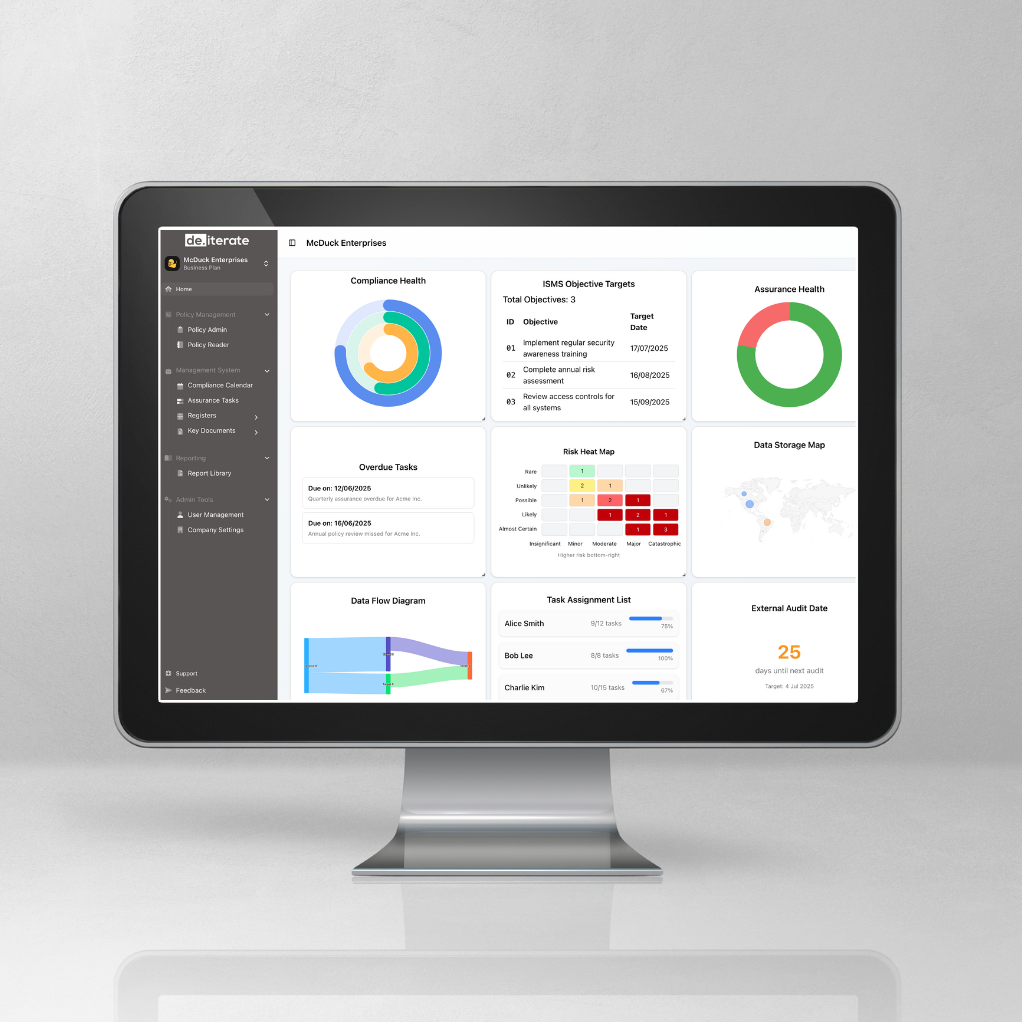
At de.iterate, we help organisations embed AI governance directly into their ISMS, without creating compliance chaos. Our platform enables you to:
- Map AI systems into your asset register
- Conduct structured AI risk assessments
- Link AI risks to treatment plans
- Track monitoring and review activities
- Maintain evidence for audits
- Align AI controls with ISO 27001 requirements
- Demonstrate that compliance is embedded, not performative
Responsible AI isn’t about slowing innovation. It’s about making sure your innovation doesn’t accidentally undermine everything else you’ve built.
Final Thought: Innovation Without Governance Is Just Risk With Good PR
AI isn’t going away. And it shouldn’t. But if your AI strategy is ahead of your compliance strategy, you’ve created a gap.
ISO 27001 isn’t a barrier to AI adoption. It’s the guardrail that makes adoption sustainable.
And in a world where AI moves fast, sustainable beats reckless every time.
Tags: