


Human Factors in Security: How People, Culture & Behaviour Impact Your ISMS
When it comes to information security, policies aren’t just paperwork—they’re your blueprint for action.
Clause 5.1 of ISO 27001 requires organisations to establish a clear set of information security policies that align with business objectives, meet applicable regulatory requirements, and provide guidance to all staff. It’s not about writing a single dusty document—it’s about setting direction and expectation.
This control ensures your organisation has a structured, approved, and maintained framework that drives decision-making and behaviour. And that everyone—from executives to interns—knows what “good security” looks like in practice.
The goal? Turn intent into action with policies that are accessible, understandable, and lived day-to-day—not just saved in a forgotten folder.
Stay tuned each month as we continue unpacking ISO 27001, clause by clause.
Intent of the Control
This control is the cornerstone of ISO 27001. Its job? To make sure your organisation doesn’t treat information security like an ad-hoc IT checklist, but instead embeds it into formal, living policy documents—ones that are relevant, reviewed, and actually used.
Think of it as: write it down, make it official, keep it useful.
Why It Matters
If you don’t have a clear, documented policy framework, then you don’t have a security strategy—you have guesswork. Control 5.1 ensures your organisation sets the direction for information security based on your business objectives, risk appetite, legal requirements, and stakeholder expectations.
In other words: it’s how you set the tone from the top.
Without this control in place, you risk:
- Inconsistent security behaviour across teams
- Unclear roles and responsibilities
- Compliance gaps
- Policies that are outdated, ignored, or completely missing
What Good Looks Like
Your policies should be:
- Documented: No verbal promises or “we usually do X”
- Approved by management: Security isn’t just for the IT guy—it needs board-level buy-in
- Reviewed at planned intervals: At least annually, or after major changes
- Communicated to relevant parties: Employees, contractors, third-party vendors
This isn’t just about the existence of policies—it’s about relevance, accessibility, and actual implementation. If your teams don’t know where to find the policies (or don’t understand them), then they’re not working.
How de.iterate Helps
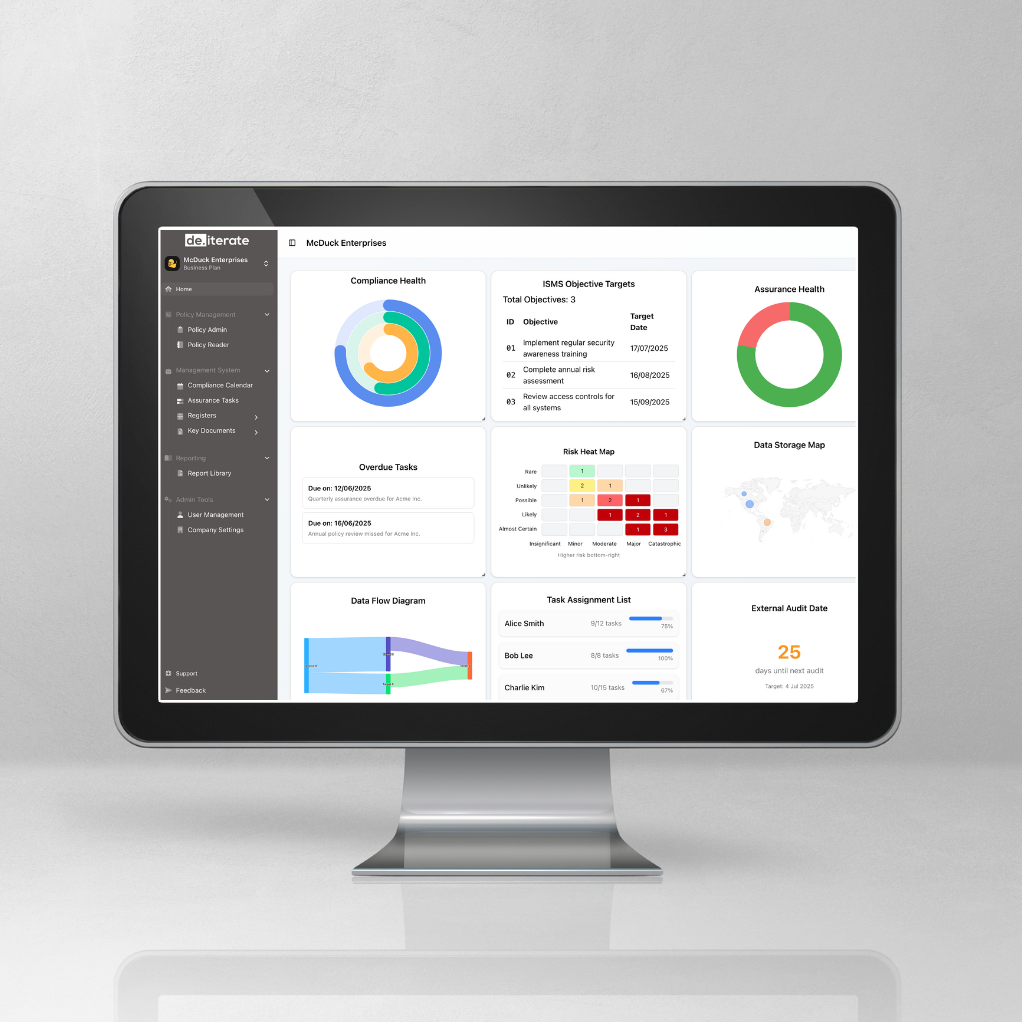
Our platform makes it easy to:
- Version-control and store policies securely in one place
- Set automated review reminders so nothing goes stale
- Assign policies to people based on role or function
- Track acknowledgement—so you know who’s read what
We’ll also help you align your security policy framework with ISO 27001 requirements, so you’re not starting from a blank page (or a chaotic Google Drive).
Because if you’re serious about information security, your policies should prove it.
Tags: