


Compliance Can’t Live in One Person’s Head
Everyone’s hyped about AI. It’s the shiny new toy promising efficiency gains, cost savings, robot-powered to-do lists, and maybe even a chance to knock off early on Fridays. But beneath all the excitement, there’s one awkward question we keep avoiding:
Do you actually know what data your AI tools are using?
Because here’s the thing: AI doesn’t work in a vacuum. It feeds off your data. And if you don’t know what it’s ingesting, or where that data’s coming from, how on earth do you expect to manage the risks?
Spoiler alert: you can’t.
AI Is Already Here. Your Risk Is Too.
You don’t need to wait for some future AI transformation moment to start thinking about governance. AI is already working inside your business.
If you’re using Microsoft Copilot, it’s already scanning your:
- Emails
- SharePoint folders
- Teams chats
- OneDrive files
That customer invoice you emailed yourself? That HR spreadsheet buried in a shared folder? Yep. It’s all there. AI already has the keys to your kingdom, and the garage.
Yet many businesses are operating like AI governance is a tomorrow problem. It’s not. It’s a right now problem.
The Two-Track AI Risk Approach (AKA: Choose Your Own Adventure)
When it comes to AI and data risk, most businesses fall into one of two camps:
- The Wait-and-See Crowd: “Let’s slow down and figure out a policy, framework, and risk process.” Sounds great, except the rest of your business is already 10 steps ahead and quietly integrating Claude or ChatGPT into their workflows.
- The YOLO Crowd: “We know the risks, but we’re doing it anyway.” (Also known as: “We’ll fix it later.”) The problem? Most employees can’t actually accept that risk on behalf of your business. You can’t shrug your way out of a data breach.
Here’s What’s Missing: Visibility. Classification. Control.
Before you switch on Copilot plug into another vendor’s AI, ask yourself:
- Do you know what data is being used to train or prompt the model?
- Have you classified your data (internal, public, personal, sensitive, confidential)?
- Can you track which vendors have access to what, and how secure their supply chains are?
You’re probably using Xero. Atlassian. Stripe. 60% of SaaS vendors now integrate AI or machine learning into their platforms. So what are they doing with your data? And how are you managing your obligations under privacy laws?
Here’s the kicker: you’re still the one responsible. Doesn’t matter if it’s outsourced, embedded, or hidden in your billing app’s small print.
If you haven’t mapped your vendors, can’t classify your data, and don’t have a structured process to assess risk, then yep, you’re flying blind.
“This Is Too Hard!” Yeah, We Know. But You Still Have to Do It.
Look, we get it. This stuff is tough. It’s messy. It’s slow. Trying to manage AI risk in a spreadsheet is like trying to track a data breach on a whiteboard. You’ll miss things. You’ll make assumptions. You’ll regret it later.
But if you don’t do it—if you don’t have proper data governance, role-based access, supplier mapping, version control, usage logs, and real-time audit trails—you’ll end up with spaghetti systems and no way to know what your AI is doing.
This isn’t a “nice to have”. It’s your obligation under the Australian Privacy Act, ISO 27001 and, increasingly ISO 42001, the world’s first AI Management System standard.
ISO 42001: Structure for the Chaos
ISO 42001 gives you a framework for:
- Identifying risks before implementation
- Managing AI transparency and accountability
- Documenting controls for data access and use
- Making governance real, not just theoretical
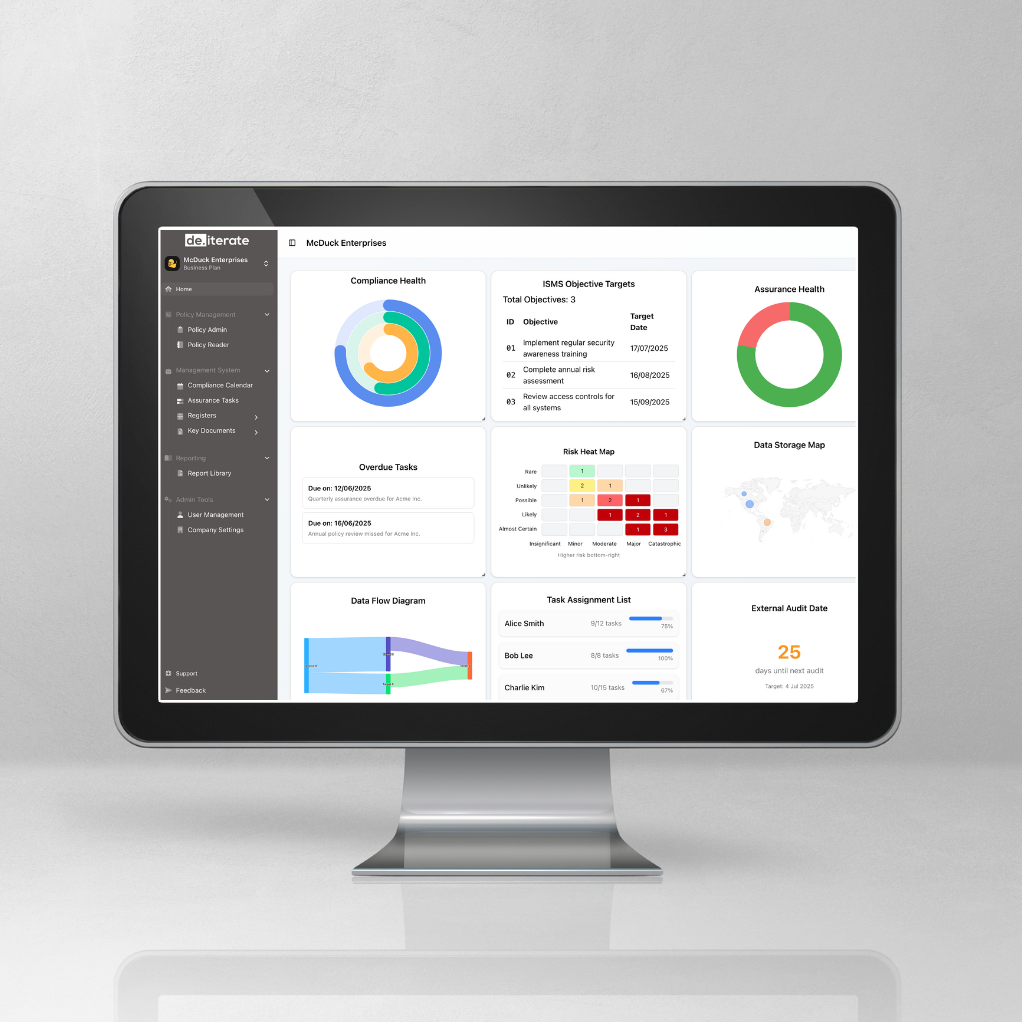
And guess what? de.iterate can help.
We’re already helping organisations move from chaos to clarity with:
- Data classification and tagging
- Vendor mapping and risk assessments
- Documentation workflows for AI risk registers and DPIAs
- Real-time visibility across systems and API integrations
- Audit-ready evidence for privacy and compliance frameworks
Don’t Let AI Governance Be Your Afterthought
AI can be magical. But don’t let the excitement blind you to the risks. Data is the fuel, and if you’re not managing it properly, your productivity dream could turn into a regulatory nightmare.
Whether you’re piloting your first chatbot or rolling out Copilot org-wide, start by getting your data house in order.
Or as we like to say: You can’t govern what you can’t see.
Tags: