

Compliance Can’t Live in One Person’s Head
When it comes to information security, data leaks aren’t just embarrassing. They can be catastrophic. Whether it’s a customer list accidentally emailed to the wrong person or source code quietly uploaded to a personal GitHub repo, data has a habit of slipping through cracks you didn’t even know you had.
That’s why ISO 27001 Control 8.12 – Data Leakage Prevention exists.
Its mission? Stop sensitive information from wandering off, getting copied somewhere it shouldn’t, or being exposed to people who have no business seeing it. This control is all about making sure your organisation has guardrails, tools, and behaviours that actively prevent data loss, accidental or otherwise.
Because when it comes to protecting information, hoping for the best is not a strategy.
Intent of the Control
The purpose of Control 8.12 is simple to state but tricky to execute: prevent unauthorised disclosure, transfer, or removal of information.
That includes:
- Stopping employees from sending private data to personal email
- Preventing files from being uploaded to unapproved cloud apps
- Ensuring data isn’t stored on unsecured USB sticks (yes, these still exist)
- Detecting unusual movements of sensitive content
- Blocking risky behaviour before it turns into an incident
Think of it as your organisation’s “digital plumbing system: a quiet but crucial set of pipes, valves, and sensors ensuring nothing leaks where it shouldn’t.
Why It Matters
Data leakage is one of the leading causes of security incidents worldwide, often not due to malicious intent, but simple human error. ISO 27001 recognises this and expects organisations to take a proactive rather than reactive approach. Without proper data leakage prevention (DLP), you risk:
- Breaching privacy laws like the Privacy Act and GDPR
- Losing intellectual property
- Damaging customer trust
- Becoming tomorrow’s headline
- Watching your security maturity evaporate overnight
And while cyberattacks are scary, the real gut punch is this: most data leaks come from inside your organisation, not outside. DLP isn’t about distrust. It’s about reducing the likelihood of mistakes.
What Good Looks Like
Effective DLP doesn’t mean locking everything down so tightly that your team needs a séance to access basic information. It means finding the right balance between protection and usability.
High-maturity organisations typically have:
1. Clear data classification and handling rules. If people don’t know what’s sensitive, they won’t know how to protect it.
2. DLP tools integrated into email, endpoints, and cloud systems. Think: warnings, prompts, or blocks when someone tries to do something risky.
3. Monitored file movement and access patterns. Not just collecting logs—understanding them.
4. Restrictions on removable media. USBs should be treated like invasive species.
5. Controls for third-party data sharing. Share intentionally, not accidentally.
6. Staff who actually know how to avoid a data leak. Training that’s practical, not death-by-PowerPoint.
7. Incident response pathways for when something does slip through. Because perfection doesn’t exist.
Good DLP feels invisible. It’s quietly doing its job in the background while your team works normally. Bad DLP, on the other hand, involves 37 pop-up warnings and a dev team plotting your demise. Aim for the first one.
How de.iterate Helps
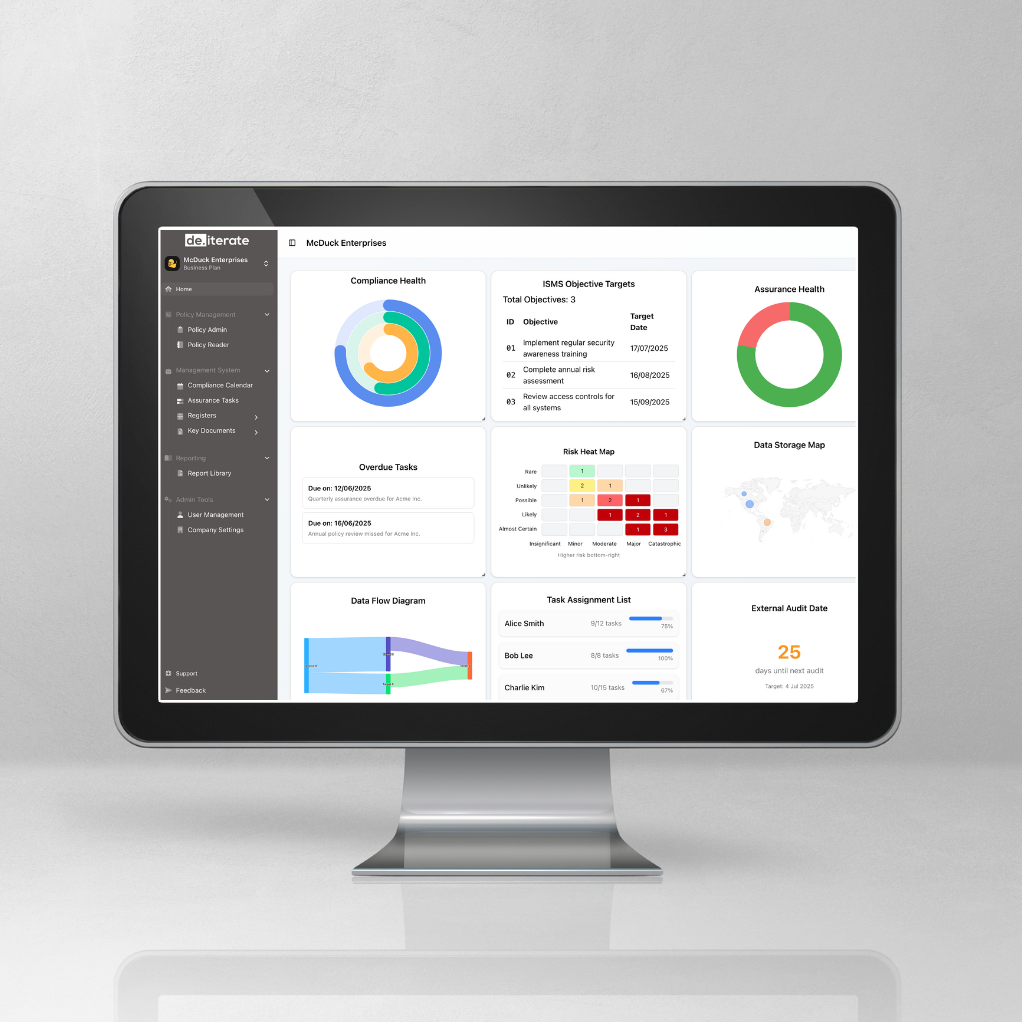
At de.iterate, we help organisations turn DLP from a buzzword into a real, measurable practice.
With our platform, you can:
- Map your data flows and identify leakage risks
- Build a practical data classification and handling framework
- Track evidence of DLP controls across your systems
- Assign responsibilities so nothing falls through the cracks
- Monitor control effectiveness continuously, not just before an audit
- Demonstrate compliance with ISO 27001 in a way that actually makes sense
And because we know startups, scale-ups, and established enterprises all work differently, we help you right-size your controls. So you’re not implementing bank-level DLP when you’re a 20-person SaaS company.
No unnecessary bureaucracy. No policy bloat. Just the right protections, at the right time, for the right risks.
Stay Tuned
Each month, The Control Room will continue unpacking ISO 27001, one clause at a time. Whether you’re building an ISMS from scratch or levelling up your current controls, we’re here to help you understand what “good” really looks like—minus the jargon.
Tags: