


Human Factors in Security: How People, Culture & Behaviour Impact Your ISMS
Every year, like clockwork, organisations across Australia find themselves caught in the same ritual: the annual audit scramble. It starts innocently enough. A reminder pops up in someone’s calendar, a Slack message asks “Hey, when’s our ISO audit again?”, and suddenly half the company is hunting for evidence like they’re in the world’s least fun Easter egg hunt.
If you’ve ever spent your December chasing log exports, rewriting policies you swear were updated last quarter, or begging your dev team for “just one screenshot, mate”, you know the pain. And let’s be honest: for many businesses, “audit-ready” is just code for “it’s time to panic in an orderly fashion”.
But here’s the kicker: while a lot of companies still treat audits as a once-a-year performance, the hidden costs (operational, cultural, financial and reputational) are much bigger than most people realise.
And worse? That annual scramble is completely avoidable. Let’s unpack why.
The Illusion of “Audit-Ready”
When most organisations say they’re “audit-ready”, what they really mean is:
- Someone’s updated the policies (at least in theory)
- The risk register has been dusted off
- Evidence folders have been… let’s say, “creatively interpreted”
- The internal audit has been done (or retrofitted)
- Everyone’s crossing their fingers that the auditor doesn’t ask too many questions
This isn’t readiness. It’s a theatrical production. Compliance theatre, complete with props, scripts, rehearsals and a desperate hope that nobody looks backstage. The reality? Being prepared for an audit is not the same as having an effective management system. But many organisations don’t see that until the long-term costs hit.
The Hidden Cost
Hidden Cost #1: Productivity Carnage
The annual audit push is one of the biggest productivity killers in the modern workplace. Teams go into emergency mode:
- Security teams pause real work to round up evidence
- Engineering teams drop sprints to produce screenshots
- HR scrambles to find training records
- Finance digs through old vendor reviews like digital archaeologists
Every hour spent on panic-driven evidence collection is an hour not spent improving security, delivering value or (dare we say it!) actually managing risk.
For some organisations, the annual audit season can swallow hundreds of hours of high-value work. Multiply that by salaries and lost opportunity cost? Ouch.
Hidden Cost #2: Compliance Debt
Just like tech debt, compliance debt builds when you delay or fake the housekeeping. Every time someone says, “We’ll fix that properly after the audit,” what they really mean is, “We’ll forget about this until next year when it’s on fire again.”
Compliance debt looks like:
- Outdated policies
- Risk registers that don’t reflect reality
- Controls implemented on paper but not in practice
- Monitoring logs no one ever reviews
- Vendor assessments done because “the template said so”
And when compliance debt compounds? It becomes far more expensive, and far more embarrassing, than just doing things properly in the first place.
Hidden Cost #3: Cultural Damage (A.K.A. People Hate Security)
Here’s something few companies admit: annual audit season breeds resentment.
Teams associate security with stress, disruption and last-minute requests. It teaches staff that:
- Compliance is a box-ticking exercise
- Audits are something to “get through”, not something to learn from
- Controls are burdens, not guardrails
- Security teams are the fun police sending calendar invites at inconvenient times
This cultural baggage is the opposite of what ISO 27001 is designed to create. A good ISMS is meant to be lived. Not panic-printed.
Hidden Cost #4: Increased Risk Exposure
When you only prepare for an audit once a year, you’re basically leaving 11 months of risk management to guesswork. Threats evolve daily. Cloud environments shift hourly. Staff turnover means access rights change weekly. Incident response procedures age faster than milk in summer.
If you’re only checking the health of your management system annually, you’re not compliant, you’re lucky. Continuous compliance isn’t just a nicer way of working; it’s a more secure way of working.
Hidden Cost #5: A False Sense of Security
One of the most dangerous outcomes of the annual scramble is the belief that: “If we passed the audit, we must be secure.”
But passing an audit only proves one thing: You provided enough evidence at that moment.
It says nothing about:
- Drift since then
- Control effectiveness
- Cultural adoption
- Actual risk posture
And auditors know it. Regulators know it. Increasingly, customers know it too.
Why Continuous Compliance Wins (Every. Single. Time.)
Continuous compliance isn’t about working more. It’s about working smarter. It means:
- Evidence is collected as work happens, not recreated later
- Controls are monitored continuously
- Risk assessments reflect the business today, not last year
- Teams embed security into normal workflows
- You’re always audit-ready, without the chaos
Instead of ramping up once a year, compliance becomes part of your operating rhythm. It’s consistent, predictable and calm.
How de.iterate Makes Continuous Compliance Easy
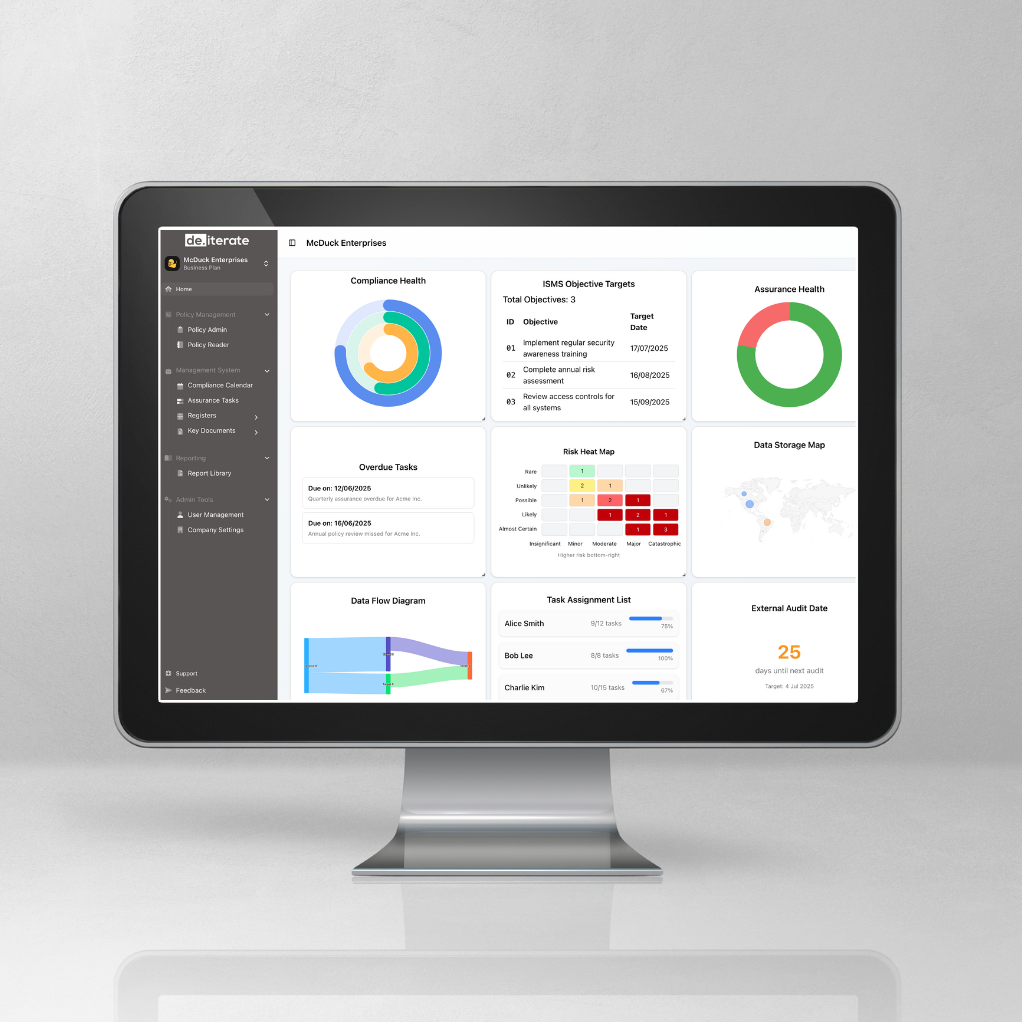
This is exactly why de.iterate was built: to turn ISO 27001 from an annual stress event into an ongoing, lived practice that organisations actually benefit from.
We help you:
- Embed compliance into real workflows
- Collect evidence continuously (and automatically, where possible)
- Reduce compliance debt
- Strengthen controls with context-aware insights
- Monitor effectiveness, not just existence
- Ensure audit-readiness every day of the year
And here’s the best part: when the auditor arrives, nothing changes because everything is already in place. No more disaster-mode. No more digging through archives. No more begging devs for screenshots like you’re trading on the black market.
Just a clean, confident, well-maintained ISMS.
The Future Belongs to the Always-Ready
The days of the annual scramble are numbered. As regulators raise expectations and AI-powered auditing becomes the norm, organisations won’t be able to hide behind once-a-year compliance theatre.
Continuous compliance isn’t just the future. It’s the only sustainable path forward. And the organisations that embrace it now? They’ll save money, reduce risk, work smarter and finally break the cycle of audit season misery.
Tags: