

Your Compliance Program Isn’t Broken. It’s Fragmented.
At some point in your growth journey, someone will ask the question…
“Are you SOC 2 compliant? What about ISO 27001 certified?”
If you’re selling into the US, it’ll be a procurement team. If you’re scaling in APAC, it’ll be an enterprise client. If you’re expanding globally, it’ll be both.
And suddenly, what started as a tidy compliance roadmap turns into a fork in the road. Do you choose one? Do you need both? Are they basically the same thing with different logos?
Short answer: they’re not the same.
Slightly longer answer: they overlap a lot.
The useful answer: if approached properly, they can absolutely complement each other without doubling your workload.
Let’s unpack it.
First: What’s the Real Difference?
ISO 27001 is an international standard for establishing, implementing, maintaining and continually improving an Information Security Management System (ISMS). It’s globally recognised, certification-based, and focused on building a structured, risk-driven management system.
SOC 2, on the other hand, is an attestation framework developed by the AICPA. It evaluates controls against the Trust Services Criteria — Security, Availability, Processing Integrity, Confidentiality and Privacy. It results in an auditor’s report, not a certification.
In practical terms:
- ISO 27001 asks: Do you have a systematic, risk-based security management system?
- SOC 2 asks: Do your controls meet defined trust principles, and are they operating effectively?
ISO is management-system focused. SOC 2 is control-and-evidence focused.
But here’s where it gets interesting.
Where They Overlap (A Lot More Than People Think)
If you line up ISO 27001 Annex A controls against the SOC 2 Trust Services Criteria, you’ll see familiar themes:
- Access control
- Risk management
- Incident response
- Change management
- Vendor oversight
- Monitoring and logging
- Policies and procedures
Both frameworks expect mature governance, documented controls, ongoing monitoring and management oversight.
If you’ve implemented ISO 27001 properly, you’ve already done much of the heavy lifting required for SOC 2. And if you’ve built strong SOC 2 controls, you’re not far off ISO readiness.
The Big Mistake: Treating Them as Separate Projects
Too many companies pursue SOC 2 and ISO 27001 as isolated initiatives.
Two different consultants.
Two different spreadsheets.
Two different evidence libraries.
Two slightly different ways of describing the same control.
That’s how duplication creeps in.
Instead of designing a unified control environment, organisations end up rewriting policies, recreating evidence, and answering the same questions in slightly different language.
It’s exhausting. And unnecessary.
Map Once, Comply Twice
The smarter approach? Build one control framework and map it to both standards.
Start with your core controls:
- Identity and access management
- Risk assessment methodology
- Change management process
- Logging and monitoring
- Incident response
- Vendor management
- Secure development practices
Then align those controls to:
- ISO 27001 clauses and Annex A
- SOC 2 Trust Services Criteria
You’re not building two systems. You’re building one strong system that satisfies two lenses.
When evidence is collected once and linked to multiple frameworks, audit preparation becomes dramatically simpler. A single control can demonstrate compliance with ISO requirements and simultaneously satisfy SOC 2 criteria.
That’s the difference between compliance chaos and compliance architecture.
So… Do You Actually Need Both?
It depends on your market.
If you’re a SaaS provider selling into the United States, SOC 2 is often non-negotiable. US customers (particularly in tech and fintech) expect a SOC 2 report as part of vendor due diligence.
If you’re working with Australian government, enterprise or multinational clients, ISO 27001 certification often carries more weight. It’s internationally recognised and signals mature governance.
If you’re expanding globally, you’ll likely need both. Increasingly, customers ask for ISO certification and a SOC 2 report. This isn’t because they’re trying to torture you, but because they operate in different regulatory and assurance ecosystems.
The key isn’t choosing one over the other. It’s sequencing strategically. Many organisations begin with ISO 27001 because it establishes a formal ISMS foundation. Once that management system is embedded, layering SOC 2 becomes significantly easier. Others pursue SOC 2 first to meet immediate US sales pressure, then formalise the ISMS and transition to ISO certification.
There’s no universal order. But there is a universal principle: build for integration from day one.
Cultural and Operational Differences to Expect
ISO 27001 audits tend to focus heavily on governance, risk management and continual improvement. Auditors want to see that security is embedded into leadership oversight and strategic decision-making.
SOC 2 reports drill into operational control effectiveness. Auditors test whether controls were functioning consistently over a defined period (for Type II).
So ISO often feels broader and structural. SOC 2 often feels deeper and evidentiary.
Understanding that distinction helps you prepare appropriately.
The Real Challenge: Ongoing Maintenance
Dual compliance isn’t just about getting certified and issued a report. It’s about maintaining alignment year-round.
Risk registers evolve. Systems change. Controls mature. Teams grow.
Without a unified compliance platform, organisations quickly fall back into siloed tracking, manual spreadsheets, and duplicated effort. And that’s where compliance fatigue sets in.
How de.iterate Makes Dual Compliance Seamless
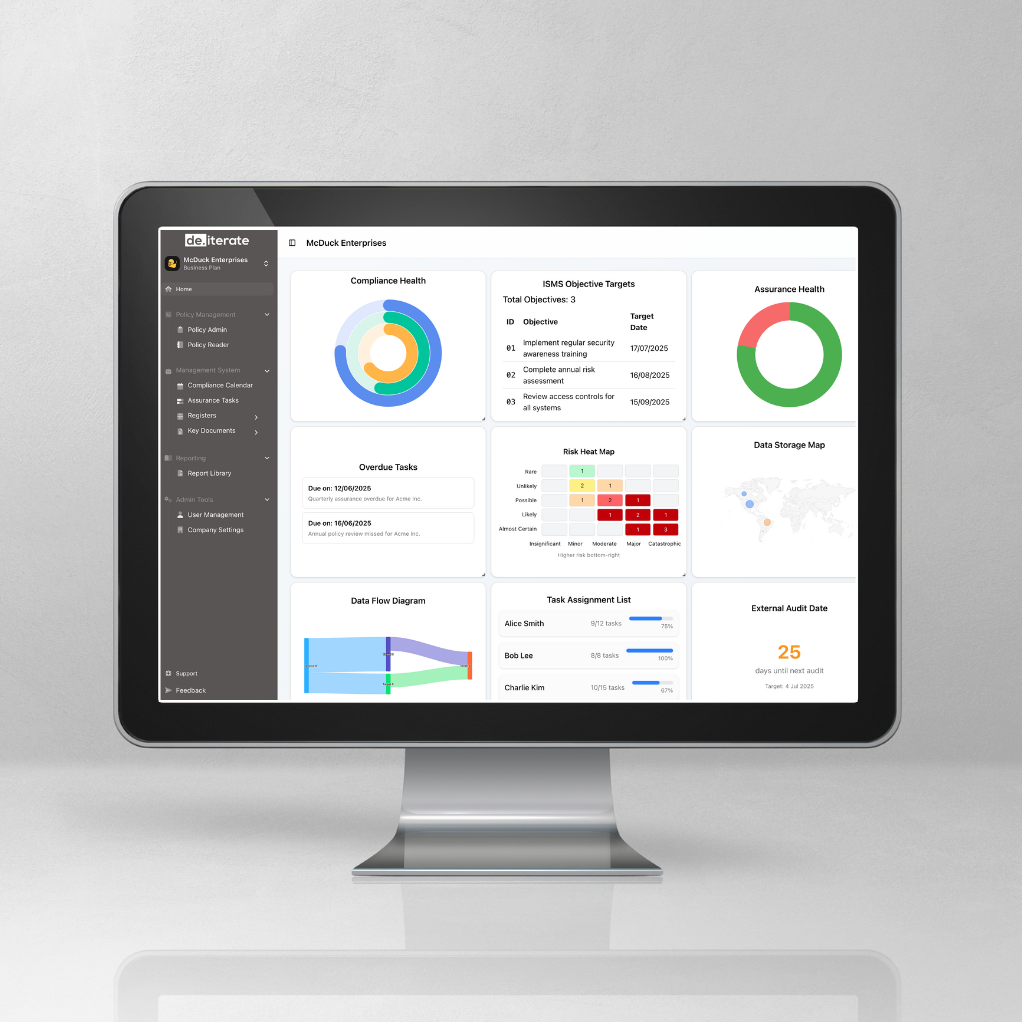
At de.iterate, we don’t see ISO 27001 and SOC 2 as separate mountains to climb. We see them as frameworks that can sit on top of the same strong foundation.
Our platform allows you to:
- Design and manage one integrated control framework
- Map controls to multiple standards simultaneously
- Collect evidence once and apply it across certifications
- Track compliance posture in real time
- Monitor control effectiveness continuously
- Reduce duplication across audit cycles
- Scale into new frameworks without starting from scratch
Instead of juggling multiple compliance workstreams, you operate one cohesive system.
That’s the difference between compliance as an obligation and compliance as an asset.
It’s Not necessarily Either/Or. It’s Build Smart.
SOC 2 and ISO 27001 aren’t competitors. They’re complementary assurance models serving different markets and expectations.
If you approach them separately, you’ll double your workload. If you approach them strategically, you’ll strengthen your governance, accelerate sales conversations, and reduce audit friction long term.
The goal isn’t to collect certifications like trophies. It’s to build a resilient, scalable compliance environment that supports your growth, wherever your customers are.
And when done properly, you won’t just pass audits. You’ll operate better because of them.
Tags: