


APRA Warns: AI Governance Needs to Be Operational, Not Aspirational
The sales process for GRC platforms is usually smooth.
The demo looks great. The dashboards are clean. The promise is compelling: “Centralise your compliance. Automate the work. Stay audit-ready.”
So the business buys in. Year one starts strong. And then something happens. Adoption drops. Data gets stale. Processes drift. People go back to spreadsheets. By year two, the platform is still there, but it’s no longer trusted.
This is more common than most vendors would admit.
The problem isn’t the platform
Let’s be clear. Most GRC platforms don’t fail because they’re technically bad.
They fail because they’re built and implemented in a way that doesn’t survive real-world use. Compliance is not a one-time setup. It’s a living system. That’s why things start to break.
Where things go wrong
1. The “setup illusion”
Most platforms shine during implementation. Everything is clean, structured and fully populated. This is because it’s done in a focused burst of effort. Policies are uploaded. Controls are mapped. Registers are created. It looks complete.
But what’s missing is this: How will this system be maintained over time? If the answer is unclear, the system starts decaying almost immediately.
2. Ownership is unclear
In year one, there’s usually a project owner. Someone driving the implementation. By year two? That ownership becomes diluted. As a result, responsibilities are unclear, tasks fall between teams and updates don’t happen. And so, the platform slowly loses relevance.
3. Evidence is not captured as work happens
This is one of the biggest issues. Evidence is often uploaded in bulk, added retrospectively and disconnected from real activity. So when it’s time to prove compliance, the evidence is incomplete, out of date, or doesn’t tell a coherent story.
Which leads to…
4. The return of audit panic
Despite having a GRC platform, the organisation still experiences last-minute scrambling, document chasing and manual fixes. This is because the platform was never embedded into operations. It was treated as a repository, not a system.
5. The system becomes too complex to maintain
Over time, controls are added, documents multiply and workflows expand. Without clear structure, the platform becomes harder to navigate, harder to trust and harder to maintain. So people disengage.
The real issue: compliance was never operationalised
Most GRC implementations focus on: “Getting everything into the system.”
Very few focus on: “Making the system part of how the business actually runs.”
That’s the difference. Without that shift, the platform will always degrade.
What successful organisations do differently
The organisations that get long-term value from their GRC platform take a different approach. They don’t treat it as a tool. They treat it as infrastructure.
1. They connect it to real workflows
- tasks are tied to real activities
- evidence is captured as work happens
- updates are part of normal operations
2. They keep it simple
Instead of over-engineering:
- they focus on what matters
- they avoid unnecessary complexity
- they prioritise usability
3. They assign clear ownership
Every part of the system has:
- a responsible owner
- defined accountability
- ongoing oversight
4. They build a compliance rhythm
Compliance is scheduled, not reactive:
- regular reviews
- recurring tasks
- visible timelines
5. They focus on maintainability
They ask: “Can we realistically sustain this system over time?”
If the answer is no, they simplify.
Where most platforms fall short
Many GRC platforms are designed to capture data and produce reports. But they don’t solve the harder problem: making compliance sustainable.
That’s why organisations end up:
- working around the platform
- duplicating effort
- or abandoning it altogether
The shift: from platform to system
If you want a GRC platform to work beyond year one, you need to shift your mindset.
From:
- implementation
- documentation
- audit readiness
To:
- operation
- connection
- continuous assurance
Because the goal is not to “have” a GRC platform. The goal is to run compliance effectively, every day.
Most GRC platforms don’t fail overnight. They fade. Quietly. Until one day, no one trusts what’s in them. And the organisation is back where it started, managing compliance through spreadsheets, shared drives and last-minute effort.
The difference between success and failure is not the platform itself. It’s whether compliance becomes something the business actually does — not just something it documents.
Need a system that lasts beyond year one?
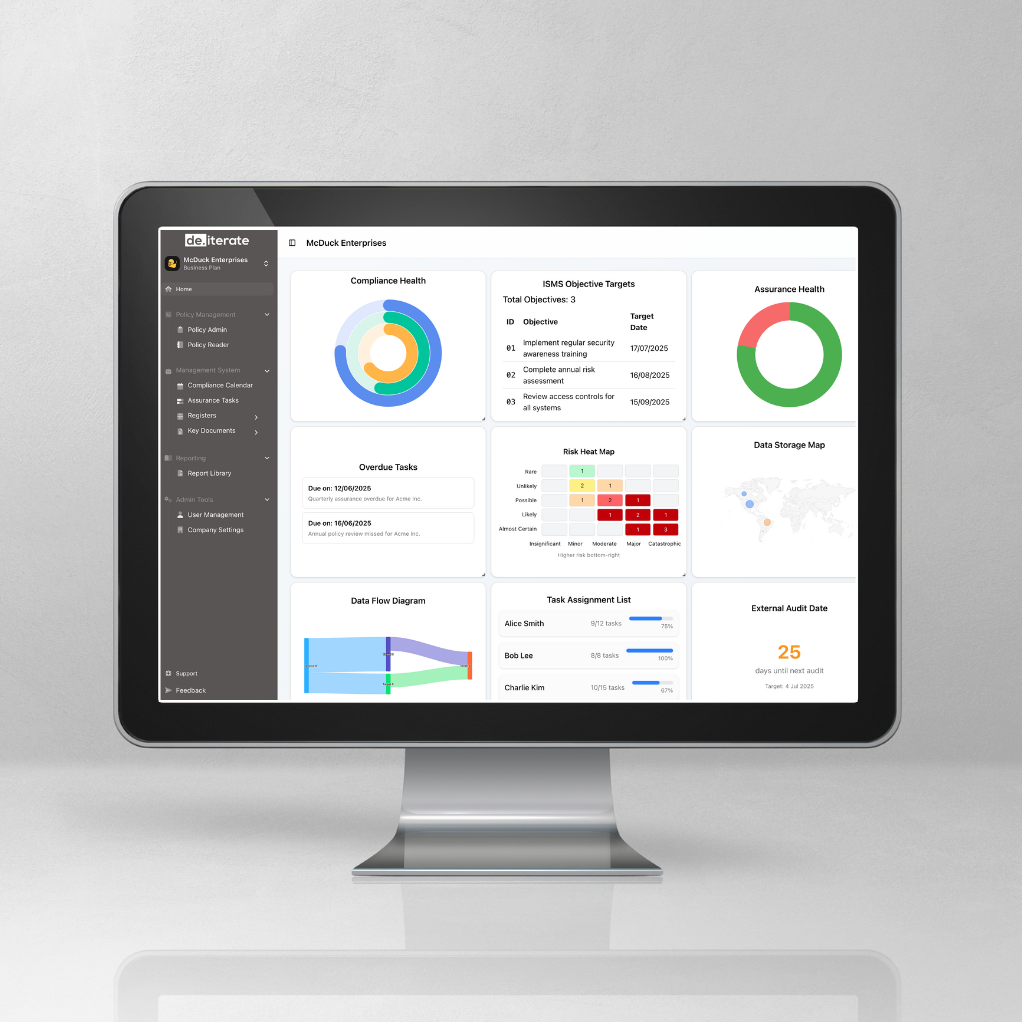
de.iterate is designed to make compliance practical, connected and maintainable.
So policies, risks, evidence, tasks and reporting don’t sit in isolation. They work together as a system the business can actually run. Not just during implementation. But every day after.
Book a demo to see how it works.
Tags:

.png?width=500&height=500&name=pen-test-risk-management%20(1).png)